Showing posts with label graduate students. Show all posts
Wednesday, April 3, 2019
2019 Images of Research Winners
#ualberta
,
#ualbertaIOR
,
graduate research
,
graduate students
,
Images of Research
,
IOR
,
phd students
,
research
,
University of Alberta
No comments
:
Congratulations to the winners of the 2019 Images of Research! We are so pleased to present the outstanding entries of the Images of Research competition for 2019.
Out of 67 eligible entries, a panel of judges chose the winners and semifinalists; all will be on display in HT Coutts Education Library from April 4 to 30, 2019.
Out of 67 eligible entries, a panel of judges chose the winners and semifinalists; all will be on display in HT Coutts Education Library from April 4 to 30, 2019.
Images of Research exhibition
Location: HT Coutts Education Library, main floor
Date: April 4 - 30, 2019


PhD - Earth & Atmospheric Sciences, Science
"Brazil is a fusion of powdery sands, mystic jungle, thundering waterfalls, and an exuberant carnival culture, much like the colors and shapes in the image presented here. Our focus is the Atlantic forest, the Mata Atlântica, which home to many species, some of which live nowhere else on this planet. Around 85% of the Mata Atlântica have been deforested and unsustainable land-use techniques, such as the slash-and-burn land management, had a detrimental effect on the fertility of the leftover soil. While providing a short-termed boost with nutrients, this approach leaves the soil depleted shortly after. Following nearly forgotten Amazonian indigenous soil management practices, we joined a project on using biochar, charcoal made of biomass, for cost-effective and sustainable soil amelioration. It was applied in different ways to optimize its beneficial effects on soil stabilization and the growth of perennial crops, such as cassava. The image is made up of leaves of cassava plants on a backdrop of nearly virgin Mata Atlântica. Small-scale plantations in the midst of the Mata Atlântica – an agroforestry approach aiming at protecting the remains of this unique habitat in harmony with sustainable food production on the already deforested land."

Re-Packing My Library: A Collection in Understanding
PhD - Drama, Arts
“Re-Packing my Library” depicts the collection process that goes into writing a dissertation. It shows a collection of books, papers, pamphlets, programs, and notes amassed over three years of research packed (once again) hastily into my father’s old bag the night before yet another departure.
Taken in my small Munich apartment, this picture shows material collected over the past three years about the Swiss-German director Milo Rau and his production company, the International Institute of Political Murder, for my dissertation. The documents in and around the suitcase are the result of the numerous research trips to performances, political actions, conferences, lectures, and interviews that have taken me – and my battered suitcase – across Europe. These research trips have helped me understand Rau’s theatre – his political aesthetic, complex themes, and directorial choices – and has given me a greater respect for Rau’s research trips (to Moscow, Bukavu, Kigali, Bucharest) in his near-obsessive search to understand war, genocide, and justice. The collection of papers and books spilling out of the suitcase are a reminder of late nights, cheap hotels, long waits at airports, and even longer train rides, but also the physical, material proof of my own obsessive, international search for understanding."

"Here, we have experimentally measured the wavefunction of a single buried arsenic atom peeking through a silicon surface. Its complex form perfectly captures one of the most fundamental properties of quantum mechanics: the location of an electron is based on probability and is never fixed. While we tend to think of electrons as being perfect little spheres existing in a single position, they really can be found everywhere around the atom. Bright spots in the wavefunction show areas with a higher probability of finding one. Arsenic atoms in silicon are used as the building blocks of quantum computers, so understanding its elusive electrons helps with more advanced designs."

"After a long day of drifting at sea, fishers go home with either a boatload of fish or nothing at all. Sunset marks the end of a day’s work of a fisher who sails on a daily basis to make ends meet. This photo was taken during my ethnographic fieldwork in Davao Oriental, Philippines. Fishing as a livelihood closely embedded in the environment is very vulnerable to the impacts of climate change. The acute changes in weather patterns compounded by the influx of commercial fishing companies forced small-scale fishers to go further offshore which increases the costs of every venture. In a landscape marked by environmental degradation and marine resource depletion caused by natural and human-induced calamities, fishers are prompted to engage in a myriad of economic activities. In this research, I take a closer look at how these fishers navigate through the waves of uncertainty. Farming and wage labor becomes the community’s adaptive strategy in the midst of economic instability. As they safely moor their boats, fishers see the sunset as a symbol for the arbitrariness of their lives. The cyclic nature of the sun setting over the ocean brings the hope of a new dawn with new opportunities."
Date: April 4 - 30, 2019
First Place $800
Abundant Recursive Mathematics Curricula Possibilities
Lixin Luo
PhD Secondary Education, Education
"A mathematics curriculum often seems be designed or delivered as linear: a sequence of predetermined, sometimes unrelated, topics with little chances for learners to revisit them from different perspectives. This suggests learning as accumulation with predictable outcomes. However, learning, observed through a complexfied worldview, is neither linear nor predictable. Learning is a self-organizing process through which a learner and her environment co-evolve, and a recursive elaboration through which a learner transforms her previous understanding. This view demands a recursive curriculum that changes along its formation. What might such curriculum be like in theory and practice is my research focus. This fractal-like image is a working visualization of recursive curricula. The nodes represent equivalent contents. Each branch represents certain mathematical/curricular event(s) that allow a content to change into or connect to another. The infinite spiral is made of loops that represent different development stages of an entry content (highlighted in green) and are ordered by the level of abstraction. The nodes on the same loop are different forms of the same content. Any node can be an entry point for many recursive curricula in the same or different dimension. This image represents abundant curriculum possibilities rather than a fixed one."
Second Place $600

Steps Towards Meaningful Physical Education
Jodi Harding-Kuriger
PhD - Elementary Education, Education
"These snowshoes were made by my Dad and Grandpa Fern. First steps: build a snowshoe form, steam lengths of straight pliable wood, bend it over the form to shape the shoes, rivet ends together, remove shoes from the form and allow to dry. Second steps: cut moose rawhide strips, once frame has dried, weave the rawhide through all the predrilled holes in the frame to create the webbing of the snowshoes. Third steps: attach the leather harnesses to the snowshoes.
Research is ceremony because it is life changing and it requires preparatory steps long before the final event (Wilson, 2008). First steps: using the Meaningful Physical Education (MPE) approach (Beni, Fletcher, & Ní Chróinín, 2017; Ní Chróinín, Fletcher, & Griffin, 2018), piece together flexible lesson plans using experiences that are enjoyable, challenging, communal, personal, and improve abilities. Second steps: weave student choices, culture, context, and community into the plans. Third steps: Reflect on teachers’ and students’ physical education experiences in all environments: air, water, land, snow & ice. Harness physical education to life long love and joy for physical activity."
Research is ceremony because it is life changing and it requires preparatory steps long before the final event (Wilson, 2008). First steps: using the Meaningful Physical Education (MPE) approach (Beni, Fletcher, & Ní Chróinín, 2017; Ní Chróinín, Fletcher, & Griffin, 2018), piece together flexible lesson plans using experiences that are enjoyable, challenging, communal, personal, and improve abilities. Second steps: weave student choices, culture, context, and community into the plans. Third steps: Reflect on teachers’ and students’ physical education experiences in all environments: air, water, land, snow & ice. Harness physical education to life long love and joy for physical activity."
Third Place $500

Biochar Bloom
Konstantin von Gunten
"Brazil is a fusion of powdery sands, mystic jungle, thundering waterfalls, and an exuberant carnival culture, much like the colors and shapes in the image presented here. Our focus is the Atlantic forest, the Mata Atlântica, which home to many species, some of which live nowhere else on this planet. Around 85% of the Mata Atlântica have been deforested and unsustainable land-use techniques, such as the slash-and-burn land management, had a detrimental effect on the fertility of the leftover soil. While providing a short-termed boost with nutrients, this approach leaves the soil depleted shortly after. Following nearly forgotten Amazonian indigenous soil management practices, we joined a project on using biochar, charcoal made of biomass, for cost-effective and sustainable soil amelioration. It was applied in different ways to optimize its beneficial effects on soil stabilization and the growth of perennial crops, such as cassava. The image is made up of leaves of cassava plants on a backdrop of nearly virgin Mata Atlântica. Small-scale plantations in the midst of the Mata Atlântica – an agroforestry approach aiming at protecting the remains of this unique habitat in harmony with sustainable food production on the already deforested land."
Honorable Mention $250

Re-Packing My Library: A Collection in Understanding
Lily Climenhaga
PhD - Drama, Arts“Re-Packing my Library” depicts the collection process that goes into writing a dissertation. It shows a collection of books, papers, pamphlets, programs, and notes amassed over three years of research packed (once again) hastily into my father’s old bag the night before yet another departure.
Taken in my small Munich apartment, this picture shows material collected over the past three years about the Swiss-German director Milo Rau and his production company, the International Institute of Political Murder, for my dissertation. The documents in and around the suitcase are the result of the numerous research trips to performances, political actions, conferences, lectures, and interviews that have taken me – and my battered suitcase – across Europe. These research trips have helped me understand Rau’s theatre – his political aesthetic, complex themes, and directorial choices – and has given me a greater respect for Rau’s research trips (to Moscow, Bukavu, Kigali, Bucharest) in his near-obsessive search to understand war, genocide, and justice. The collection of papers and books spilling out of the suitcase are a reminder of late nights, cheap hotels, long waits at airports, and even longer train rides, but also the physical, material proof of my own obsessive, international search for understanding."
Honorable Mention $250
Probability
Taleana Huff
PhD - Physics, Science
"Here, we have experimentally measured the wavefunction of a single buried arsenic atom peeking through a silicon surface. Its complex form perfectly captures one of the most fundamental properties of quantum mechanics: the location of an electron is based on probability and is never fixed. While we tend to think of electrons as being perfect little spheres existing in a single position, they really can be found everywhere around the atom. Bright spots in the wavefunction show areas with a higher probability of finding one. Arsenic atoms in silicon are used as the building blocks of quantum computers, so understanding its elusive electrons helps with more advanced designs."
People’s Choice $250

Sunset: Uncertainties and opportunities
Deanna Joyce Neri
Masters - Anthropology, Arts"After a long day of drifting at sea, fishers go home with either a boatload of fish or nothing at all. Sunset marks the end of a day’s work of a fisher who sails on a daily basis to make ends meet. This photo was taken during my ethnographic fieldwork in Davao Oriental, Philippines. Fishing as a livelihood closely embedded in the environment is very vulnerable to the impacts of climate change. The acute changes in weather patterns compounded by the influx of commercial fishing companies forced small-scale fishers to go further offshore which increases the costs of every venture. In a landscape marked by environmental degradation and marine resource depletion caused by natural and human-induced calamities, fishers are prompted to engage in a myriad of economic activities. In this research, I take a closer look at how these fishers navigate through the waves of uncertainty. Farming and wage labor becomes the community’s adaptive strategy in the midst of economic instability. As they safely moor their boats, fishers see the sunset as a symbol for the arbitrariness of their lives. The cyclic nature of the sun setting over the ocean brings the hope of a new dawn with new opportunities."
Monday, March 25, 2019
Using Statista to Find Data and Statistics

- Do you want to know about projected job growth by Canadian industry as you consider what discipline to study?
- Or maybe you need to know which social media platforms are used worldwide for your communications paper?
- Do you need statistics about backpack sales in a visual format for a business class presentation?

Using Statista, you can find data visualizations and reports about:
- Societal statistics including employment, poverty, health, and population
- Company, industry, brand, and consumption data
- Media and marketing statistics
- Sales, forecasts, revenue, and users
- Information from 21 countries, including Canada
Friday, March 22, 2019
How Have Our Photos Changed Since the 19th Century?
I immediately signed up for “19th century photographic prints” as I am a freelance photographer outside my work at the library. I’ve always been intrigued by old photographs as they reveal unspoken aspects about life in a different time.
We live in an era where the digital photograph has made photographs mundane everyday tools. We snap selfies of ourselves in the mornings when we’re having a particularly good hair day, we shoot funny things we witness on our way to school or work and the every-day electronic exchange of photos can make us take them very much for granted. How often do we look at our photos and how many of them become forgotten on our devices? In a world full of photos, it is difficult to conceptualize a time when photographs did not exist.
One of my favourite reads of the past year was Capturing the light : the birth of photography, a true story of genius and rivalry by Roger Watson and Helen Rappaport. The book details the haphazard history of how photography was invented and the many players (Niépce, Daguerre and Henry Fox Talbot to name a few) that played a role in its development. With these ideas on my mind lately, I was quite excited when I saw the workshop on 19th century photographs workshop as an opportunity to learn from experts about how photography was practiced in the past, and to actually see examples of the different types of prints in person.
Bruce Peel Special Collections Conservator Carolyn Morgan lead the session which showcased many different types of early photographs. Starting with early Daguerreotypes, Ambrotypes, to Tintypes, Carolyn explained the processes by which these different types of prints were created.
One of my favourite reads of the past year was Capturing the light : the birth of photography, a true story of genius and rivalry by Roger Watson and Helen Rappaport. The book details the haphazard history of how photography was invented and the many players (Niépce, Daguerre and Henry Fox Talbot to name a few) that played a role in its development. With these ideas on my mind lately, I was quite excited when I saw the workshop on 19th century photographs workshop as an opportunity to learn from experts about how photography was practiced in the past, and to actually see examples of the different types of prints in person.
Bruce Peel Special Collections Conservator Carolyn Morgan lead the session which showcased many different types of early photographs. Starting with early Daguerreotypes, Ambrotypes, to Tintypes, Carolyn explained the processes by which these different types of prints were created.
Laid out on the tables in the Peel Library these photos, most of which were portraits, all exhibited different features depending on the processes that were used to create them. Some were dark and very detailed, others were faint or looked almost like drawings rather than photographs.
One of the key things I learned is that Daguerreotypes were printed on a sheet of silver plated copper, and they can easily be identified by their mirror-like surface. Daguerreotypes as were often encased in a frame to prevent tarnish.
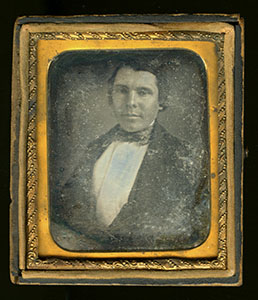 |
| Daguerreotype example |
One of the key things I learned is that Daguerreotypes were printed on a sheet of silver plated copper, and they can easily be identified by their mirror-like surface. Daguerreotypes as were often encased in a frame to prevent tarnish.
 |
| Tintype example |
Later Tintype photos were imprinted onto iron plates (metal) and Ambrotype were on glass with a dark paper or material backing.
 |
| Ambrotype example |
The workshop reinforced how early photography was expensive and only really the wealthy could really afford to have photos taken. It also revealed to me how one of my favourite past times was once heavily linked with chemistry and chemical processes.
I often wonder what the earliest photographers would think about how we now snap pictures of our food to disseminate with everyone we know, or text shots of store shelves as information to a friend or partner who is not present. Even though our digital equivalents manifest instantly and can be sent across the world in seconds, our photos still reveal details of our lives and are very much a part of the history photography. I only hope someday hundreds of years from now, people will be able to view them with the same fascination as we view early photographs.
Look for upcoming Bruce Peel workshops you can go to the library workshop page and filter the sessions for just Bruce Peel Special Collections.
You can also read more about 19th Century Photography in books from our collection.
I often wonder what the earliest photographers would think about how we now snap pictures of our food to disseminate with everyone we know, or text shots of store shelves as information to a friend or partner who is not present. Even though our digital equivalents manifest instantly and can be sent across the world in seconds, our photos still reveal details of our lives and are very much a part of the history photography. I only hope someday hundreds of years from now, people will be able to view them with the same fascination as we view early photographs.
Look for upcoming Bruce Peel workshops you can go to the library workshop page and filter the sessions for just Bruce Peel Special Collections.
You can also read more about 19th Century Photography in books from our collection.
Wednesday, March 13, 2019
Vote in the People's Choice Award for 2019 Images of Research
At its essence, the University of Alberta Images of Research competition challenges our graduate students to share their research in a way that society can relate to and understand.
The judges have met, debated, and chosen the winners, apart from the People's Choice Award, who will be revealed at a reception on April 3. The coveted title of 'People's Choice' and the $250 prize is chosen by you from the 24 semifinalists.
The People's Choice Award voting is now open. All of this year's semifinalists will be displayed at Coutts Education and Kinesiology, Sport, and Recreation Library on North Campus, University of Alberta throughout April.
How to vote:
1. Click here to view the finalists online and vote for your favourite entry with the best image and description.2. Share this post with your community!
Voting is open to the public from March 13 to 20, 2019.
Friday, February 1, 2019
Now Open! Library Publishing for Open Textbooks
faculty
,
graduate students
,
OER
,
OJS
,
open access
,
services
No comments
:

OER are teaching and learning materials that are accessible without cost and allow for free use, reuse and redistribution. OER often have a Creative Commons license that states specifically how the material may be used, reused, adapted, and shared.
If you are interested in creating, adapting or using open textbooks or other OER in a course, the Libraries’ can provide you with the tools, expertise, and free hosting to get you started.
For more information, see www.library.ualberta.ca/publishing or contact library.publishing@ualberta.ca to see if our service is the right match for your learning materials. You can also check out the OER Awards, to see if you are eligible to apply for additional support for your project.
Friday, January 11, 2019
Capture the Essence of Your Research in a Single Image
#ualbertaIOR
,
announcements
,
collection
,
Competition
,
Contest
,
era
,
Exhibition
,
graduate research
,
graduate students
,
Images of Research
,
IOR
,
research
,
ualberta
No comments
:

The University of Alberta Images of Research Competition & Exhibition is the ultimate test of knowledge transfer for any graduate student. The challenge is to portray your research in a single image. Are you up for the task?
Semifinalists will have their image and description immortalized in the University of Alberta's Education & Research Archive (ERA) Images of Research Collection.
Submissions will be accepted from January 21, 2018 to February 8, 2019. Visit the competition website for more details uab.ca/ior.
We will be holding two submission preparation workshops on January 17 and 23, 2019. The workshops are approved as Faculty of Graduate Studies & Research Professional Development credits. Register for the workshops here.
To spark inspiration here are some entries from the 2018 competition and visit the Rutherford Library Galleria's teaser exhibit happening throughout the month of January.
Augmented Phobia by Anna Chakravorty


The University of Alberta Images of Research Competition & Exhibition is brought forth through continued partnership of University of Alberta Libraries, Faculty of Graduate Studies & Research, and Campus Design and Print Solutions.
Follow competition updates on social media @uofalibraries @UAlbertaFGSR #ualbertaIOR
Friday, October 5, 2018
Open Access Week 2018
Here are a few local events you can attend! Find many more on the global 2018 OA Week Calendar, or follow #openaccessweek2018 on Twitter.
Monday, October 22
11:00 AM -12:00 PM, Senate Chamber (326 Arts and Convocation Hall)
Has the Open Access Movement Ossified? What Gains Remain to be Had and What Work Needs to be Done
As the 10th annual Open Access (OA) week begins, it is important to not just celebrate the gains made but also interrogate what the future holds for the OA movement.
Michael B. McNally from the School of Library and Information Studies will argue that with many substantive gains already made, from the adoption of OA in various funding models to the emergence (and capture) of OA as business model for scholarly publishing, that the OA movement has evolved into an increasingly ossified movement. The dream of OA as the mode for scholarly communication is dead.
Michael B. McNally from the School of Library and Information Studies will argue that with many substantive gains already made, from the adoption of OA in various funding models to the emergence (and capture) of OA as business model for scholarly publishing, that the OA movement has evolved into an increasingly ossified movement. The dream of OA as the mode for scholarly communication is dead.
Dale Askey, Vice-Provost and Chief Librarian, will respond to the presentation and provide his insights on what the future of scholarly publishing holds and what this means for advocates OA advocates. After the presentation and response there will be time for questions and discussion with the audience.
Registration now open!
3:30 PM - 5:00 PM
Documentary Screening: Paywall the Business of Scholarship

Join us at MacEwan University
Thursday, September 27, 2018
Spotlight on Open Educational Resources
Spotlight on Open Educational Resources
 The fall semester is well on its way, but it is always a good time to think about how Open Educational Resources (OER) fit with your teaching, learning or research!
 We have talked about OER before, but we wanted to remind you of some of the great opportunities to get involved with this exciting movement.
To catch you up, OER are teaching, learning and research materials that are in the public domain and allow for remixing, redistribution and sharing. They can include everything from entire courses to whole textbooks, various types of media, or assessment materials.
Anything that you use for teaching and learning in your courses could probably also be an OER! It is all about how others can access the content to adapt it to their context, and even share those materials after they have made those changes. This collaborative approach to learning is at the heart of the OER initiative.
Hint: This didn’t give you enough information? Watch this video to learn more
Why Do Libraries Care about OER?
Meeting the needs of our community and lowing the barrier to information is always a library's mission. For example, did you know that the University of Alberta Libraries has a textbook lending program to help lower the barriers to accessing expensive textbooks? OER are another tool in our toolbox to share new way to think about teaching and learning.Who Cares about OER ?
The most common consideration for OER is the rising cost of textbooks and the burden on students. This fall the University of Alberta Students’ Union hosted the Be Booksmart Fair to share their concerns about textbook costs.
As a large campus building up professionals for a variety of fields, the knowledge of OER is something that our students can take into their professionals lives to have continued access to scholarly dialogue and encourage lifelong learning.
"The integration of an OER in your classroom means you are removing barriers for students to connect with course content. Therefore, students are more engaged in the class, they produce higher quality work, and have an enjoyable and accessible experience at a leading institution in Canada."
The University of Alberta's VP Academic Akanksha Bhatnagar
Upcoming Events
Open Educational Resources ShowcaseDecember 30, 2018 1:30 PM - 3:00 PM
Cameron Basement B-12
Remixing and Revising Free Teaching Materials
November 19, 2018 12:00 PM - 1:20 PM
Cameron Basement B-12
Open Educational Resources Showcase
December 6, 2018 11:00 AM - 12:30 PM
Cameron Basement B-12
Taking Action
There are many low barrier ways to explore an interest with OER, or just learn about your community supports. Read more about the open education movement on the UA Libraries Open Education libguide and consider contacting our OER Subject Librarian. You may also want to check out the Centre For Teaching and Learning's Open Education page and consider booking a consultation, or join the UofA OE Interest Group. This article is licensed under a CC BY licence. Visit Creative Commons to learn more about what this means.
Wednesday, September 19, 2018
Research Computing Bootcamp - Sept 24-28
digital initiatives
,
digital scholarship
,
faculty
,
graduate students
,
research data management
,
research impact
,
researchers
No comments
:
Join in Research Computing Fall Bootcamp events beginning September 24!
Patrick Mann, Director of Operations at WestGrid, kicks off a week full of research computing activities with valuable tips for writing a research allocation proposal. Mann’s areas of focus include cloud computing, virtualization, networking, systems architecture, system administration, and collaboration.
Additional events will run through September 28 and include a marketplace, one-on-one consultations, workshops on Shell, Regex, OpenRefine, and more!
Sign-up for Fall Bootcamp events running September 24 - 28 here: https://ist.ualberta.ca/blog/events/get-ready-research-computing-fall-bootcamp
Fall Bootcamp provides the opportunity to connect with colleagues and research computing experts to share knowledge and best practices. Research Computing Fall Bootcamp is held in collaboration with University of Alberta Libraries and Information Services & Technology (IST).
Patrick Mann, Director of Operations at WestGrid, kicks off a week full of research computing activities with valuable tips for writing a research allocation proposal. Mann’s areas of focus include cloud computing, virtualization, networking, systems architecture, system administration, and collaboration.
Additional events will run through September 28 and include a marketplace, one-on-one consultations, workshops on Shell, Regex, OpenRefine, and more!
Sign-up for Fall Bootcamp events running September 24 - 28 here: https://ist.ualberta.ca/blog/events/get-ready-research-computing-fall-bootcamp
Fall Bootcamp provides the opportunity to connect with colleagues and research computing experts to share knowledge and best practices. Research Computing Fall Bootcamp is held in collaboration with University of Alberta Libraries and Information Services & Technology (IST).
Monday, June 25, 2018
Five Ways Browzine Will Revitalize Your E-Journal Experience
 Have you tried Browzine yet? If not, you’re missing out on a fantastic way to stay up-to-date on all your favourite journals wherever you have a network connection. Best of all, Browzine offers free apps for a plethora of desktop and mobile devices, meaning all current University of Alberta students, faculty and staff can take advantage of all Browzine has to offer. Here’s five more reasons you should be using Browzine:
- Planning on sitting back with the latest issue of your favourite journal? Browzine’s simple bookshelf interface gives you the ability to view single articles and full issues of journals.
- Curious about what other journals are available in your area of interests? You can browse an incredible array of journals available through UAlberta libraries and open access publishers using Browzine.
- Do you eagerly await the release of the latest issues of your favourite titles? You can save your favs to your personal bookshelf and get alerts when new issues are published.
- Headed somewhere where there’s no internet access? You can save articles to your mobile device for offline viewing.
- Discover an article that complements your research? You can easily export the article’s reference data into the reference manager of your choice.
Thursday, April 5, 2018
Announcing the Winners of Images of Research 2018
Drum roll please….
We are so pleased to present the winners of the Images of Research competition for 2018. Out of 100 eligible entries, a panel of judges chose the winners and semifinalists; all will be on display in Cameron Library from April 5 to 30, 2018.
Date: April 5 - 30, 2018
We are so pleased to present the winners of the Images of Research competition for 2018. Out of 100 eligible entries, a panel of judges chose the winners and semifinalists; all will be on display in Cameron Library from April 5 to 30, 2018.
Images of Research exhibition
Location: Cameron Library, main floorDate: April 5 - 30, 2018
First Place $800
Augmented Phobia
Anna Chakravorty
Master's - Arts, Visual Communication, Design
"Most people who suffer phobias (around 60–80%) never seek treatment and of those who do seek treatment, approximately 25% either refuse exposure therapy when they hear what it entails or drops out of therapy. One of the reasons for this refusal data could be that the main feature of exposure is confronting the feared stimuli, which some people may find too frightening. New efforts are needed to increase the number of phobia sufferers who benefit
from exposure therapy. Augmented reality systems give users a feeling of presence and reality judgment that can be exploited to treat some psychological disorders. My master's research focuses on understanding the human interaction with the technology and to determine if augmented reality can help people to overcome their phobias. To answer this, a series of testing would involve where the stimuli would render from basic shapes and forms to more real objects to a stage where the patient would be able to hold and interact with the stimuli. This would help people to expose themselves to their fears as well as act as a self-therapy."
Second Place $600
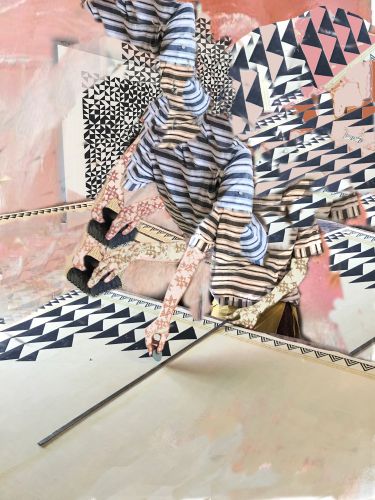
Absorption Experience
Kim McCollum
Master's - Arts, Painting
“My research explores the relationship between textile work and abstract painting. This image is a digital collage that combines several photos of me learning to block print in India. These photos are mixed with digital paint and pattern to create an image that expresses the feeling of flow created when making something by hand. I wanted to visually capture the feeling of being so completely engrossed in the process of creating something that the creation and the creator become one. Making digital collages like this is the first step in my creative process. I combine digital painting with images of textile art to make connections between the two mediums and generate new ideas. My next step involves creating large-scale physical artworks inspired by my digital collages. This involves using painted and hand-woven components to create woven paintings. Referencing the visual histories of both ‘high’ and ‘low’ art has potential to create new connections and break down barriers that limit the influence of certain work based on medium.”
Third Place $500
Learning to see through the hand
Ron Wigglesworth
PhD - Education, Secondary Education
"Rapid development of digital technology is inevitable and will call for continued changes in education. If kinaesthetic drawing amplifies a student’s sensibility and sensitivity to what is being observed, then might we benefit by utilizing our haptic senses more broadly in our increasingly-digitized schools? Becoming aware of what we do not see enriches our understanding of what we do see. Perhaps slow drawing by hand might offer a powerful enhancement to the current ocularcentric domination in the sciences. Pedagogical implications from drawing could enhance understanding and observation skills in many fields where the mediated image is used. My research asks: what drawing can still offer in an increasingly digital/digitized world?
Digital technologies offer powerful tools, but the immediacy of a digital image does not guarantee quality nor assure learning. The drawing process changes the subject; undergoing a change in sensibility. Drawing requires thoughtful observation, discipline and practice, all of which are essential skills in ensuring learning success. Faster is not better. Drawing has the potential to slow down students scrambling in a digital world. Learning is a process, and drawing is a way of opening the eyes and a way of thinking and feeling. Thinking emerges from the process of drawing as new perceptions are created."
Honorable Mention $250
Sans Escher
William Northlich
PhD - Arts, Music
"Sans Escher is a graphic musical score. The aesthetic and design vision behind Sans Escher is musical indeterminacy, conveyed by abstract of conventional music notation. Such a graphic score may be observed as an independent piece of artwork, or as a musical score that may be performed by any number of players consisting of any instrumentation with the option of including additional staging and spatial designs, all of which may be determined by the ensemble. Precise elements of dynamics, articulations, length of musical passages, and pitch are also up to the discretion of the ensemble or individual player.
My doctoral research consists of the confluence of electronic music and improvisation, and how improvisatory methodologies are effective in representing performances of electronic music visually. Graphic scores are indispensable in visually representing unorthodox processes, gestures, sonic states, and aesthetic visions. Thus, audiences are able to make profound connections with related musical material by gaining insight into performative decisions, sonic results, and the composer’s inspiration."
Honorable Mention $250
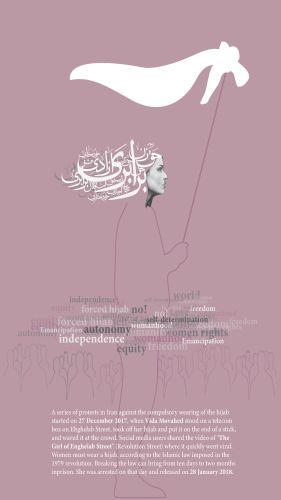
The Girls of Enghelab Street
Zohreh Valiary
Master's - Arts, Arts & Design
"An often-cited example of a country with a highly restricted society is Iran. Iranian women’s history is a labyrinthine road of darkness, patriarchy and suppression. After the invasion of Muslims, women started losing their equal rights, and the situation continued to be more or less the same until the end of the 19th century when some movements started to happen toward the emancipation of women. These movements, that still are going, on have a long way to go to reach the goal of equal rights and freedom for women in my motherland.
I based ""the Girls of Enghelab Street"" on the action of Vida Movahed, a young Iranian woman who, on December 27, 2017, stood on a platform in Enghelab street in Tehran, tied her white hijab (a symbol of protest against mandatory hijab created by Masih Alinejad, the founder of the online movement ""My Stealthy Freedom""), to a stick, and waved it at the crowd until the authorities arrested her. After Vida Movahed's action more women started doing the same to show their union and support for the movement. Twenty-nine women were arrested in the two months leading up to February 2018.
The aim of my research is to explore how visual communication design might provide a medium through which one can foster awareness and build empowerment in my target audience of young, educated Iranian women, aged eighteen to twenty-five."
People’s Choice
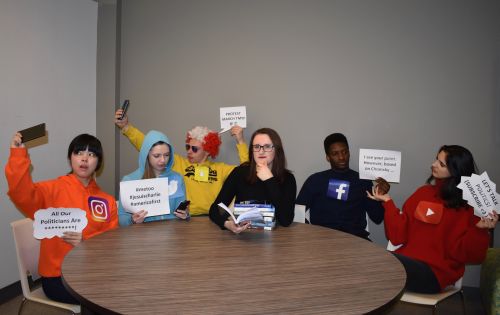
Politicizing Social Media $250
Jennifer Zeller
Master's - Arts, Philosophy
“Politicizing Social Media” portrays everyday social media users and some of their political opinions. If inappropriately phrased or posted in an unfitting format, these perspectives tend to be disregarded and considered irrelevant or unpolitical by academics. This has resulted in unbalanced, if not ignorant, academic discourses on social media as most scholars have only focussed on the political potentials of platforms such as Facebook, Twitter or Youtube – not their disadvantages or “unprofessional” contents. However, the original meaning of politics – from Greek polis – revolves around the ordinary people, not merely a political elite. Correspondingly, my research aims at constructing a philosophical and political theory of social media by analysing often disregarded, but nonetheless political contents and by using theories such as those from Hannah Arendt, Jürgen Habermas and others. Thus, I am in the middle of the picture with my books, trying to make sense of how politics are made on social media around me from a scientific point of view.”
Wednesday, March 28, 2018
Students Needed: Help Us Improve the Accessibility of our Libraries

We are looking for students (open studies, undergraduate, or graduate) to participate in one or more of the following assessment activities:
• Walk through of Library Spaces
• Focus Group discussing Library Accessibility
• Usability Testing on the library website
The sessions will take between 1-3 hours depending on the assessment activity.
We are aiming to recruit students who identify as having a disability or find it challenging to access library resources.
By participating in this project, you will receive $25 in ONECard cash.
By participating in this project, you will receive $25 in ONECard cash.
If you are interested in participating in this project, please contact Kirsti VanDornick at kirstiv@ualberta.ca.
You are also invited to complete this 10 minute survey about your experience with the library programs and services. Participation in this survey is unpaid. https://qtrial2018q1az1.az1.qualtrics.com/jfe/form/SV_3WCdazS7YrKG0wR
Monday, January 15, 2018
Interlibrary Loan Survey
The University of Alberta Libraries is conducting an online survey regarding our Interlibrary Loan Services, and we would love to hear from you!

Your feedback will give us valuable insight into how our services can be improved, as well as address any concerns that users currently have while requesting Interlibrary Loan material. The survey will remain open until February 7, 2018.
To complete this survey, please follow the link below:
https://libraryualberta.ca1.qualtrics.com/jfe/form/SV_9KRgDT4IwLrtkLb
If you have any questions regarding this survey, please contact Victoria Wong at vlwong@ualberta.ca, or at 780-492-7905.
Monday, October 30, 2017
Students Needed: Help Us Improve Our Website

By participating in this website usability study, you will receive $25 in ONECard cash. To apply, please complete this form and you will be contacted if selected.
Welcome COMPASS: The Student Anthropology Journal of Alberta

On October 16, we welcomed a brand new publication into the world! COMPASS: The Student Anthropology Journal of Alberta published its inaugural issue, featuring articles from undergraduate, MA, and PhD research of students at the University of Alberta, MacEwan University, and the University of British Columbia, spanning topics as diverse as investigating the possibility of celiac disease in Ancient Rome, to using fossils to identify the origin of stone tools in southern Alberta.
We interviewed the Editors-in-Chief of COMPASS, Katherine Bishop and Victoria van der Haas, both PhD Candidates in Anthropology at the University of Alberta, about the value of student journals.
__________________
Why do you think student journals are important?
Victoria: For me, students journals are important for two reasons: experience and learning. This goes for the writers as well as the people behind the journal. It allows students to explore and share research is a non-threatening environment, which is so important for their growth and development in academia. In addition, it also provides them with a bit of exposure.
Katherine: I love working with student journals; they provide so many different opportunities. As an author you learn how to work with feedback. You get a taste for publication in a low-stakes environment and get a final product that looks impressive on a resume. It allows you to grow as a researcher and experience one of the processes that professionals in our field must go through as part of their careers. As a reviewer it will also improve your writing, reading, and ability to give constructive feedback.
What have you learned from your work on student journals?
Victoria: The most important thing I learned is just how much work actually goes into putting together a journal. It seemed like a very straightforward process, but there were more steps involved than I initially assumed. It taught me the importance of time management.
What advice would you give to students who are interested in starting or volunteering for a student journal?
Victoria: Make sure you commit and you have the time to do it. As interesting and exciting as it is to start such an endeavour, you must realize nothing will happen if you don't put in the work. It will take time to review a paper, send it back to the author(s), review it again, copy-edit, etc. COMPASS started a year ago, but only now are we able to put out our first issue. Teamwork matters!
Katherine: If you have the time and are interested in becoming a better writer, editor, and reader of different works – just do it! The UofA’s campus is an incredible environment to help you get involved and succeed with your initiatives. There are lots of different student journals on campus that are always looking for people to help them. If there isn’t one that relates to your research, consider starting your own. That is what happened with COMPASS. We reached out to our department’s library liaison and he soon put us in contact with Sonya Betz, Digital Initiatives Projects Librarian. Not only that, but by contacting other student journals we were able to see what did or did not work for them. The Journal community is very supportive and a great resource.
Anything else you want to say about journal publishing?
Katherine: Work with people that you enjoy. People who have similar work ethics, goals, and understandings. My Co-Editor has been a huge help during stressful times throughout our project. Being on the same page about what we wanted to accomplish, how, and recognizing that this was a “for fun” volunteer initiative went a long way for our continued success together.
Victoria: Enjoy what you do. Everything will be a lot easier if you treat it as a fun side-project, not a job. As a student you'll always have a million things going on, so you need to make sure this isn't just another "chore".
_______________
In addition to COMPASS, the UofA Libraries supports several actively publishing student journals through its open access journal publishing service, including:
For more information about the Libraries’ free open access journal hosting service, please contact Sonya Betz, Digital Initiatives Projects Librarian (sonya.betz@ualberta.ca).
Tuesday, August 29, 2017
Re-discover Academic Journals with BrowZine

In this age of straight-forward Google searches and online shopping, we often forget the power of browsing.
Companies, streaming services and, yes, even libraries are struggling to replicate browsing experiences in the virtual world to reveal their products and content. Within academia in particular, the evermore digital nature of scholarly communication, causes the unfortunate side-effect that we seldom 'browse' the library shelves or flip through complete journals anymore. This is where the BrowZine, a mobile and web-based application, comes in.
BrowZine, is a "journal engagement platform" by library technology company Third Iron that provides the simple service of enabling library users to 'browse' journal content that the libraries subscribes to.
You can download the free apps for several types of mobile platforms or you can access a web-based version on a desktop or laptop. After quickly creating an account with your university email account you can start to fill your virtual shelves with the journals relevant to your field. You can browse by subject matter or input names of specific journals. As journals update content overtime, the BrowZine app notifies you. You can then skim the titles of the articles and save any you wish to read later.
BrowZine also takes you directly to the article PDF version (if the publisher provides one) so you can read it within the app, essentially recreating the 'flipping through a journal' experience. BrowZine will be of most use to faculty and grad students trying to keep up with research publications in specific fields of study.
You can download the free apps for several types of mobile platforms or you can access a web-based version on a desktop or laptop. After quickly creating an account with your university email account you can start to fill your virtual shelves with the journals relevant to your field. You can browse by subject matter or input names of specific journals. As journals update content overtime, the BrowZine app notifies you. You can then skim the titles of the articles and save any you wish to read later.
BrowZine also takes you directly to the article PDF version (if the publisher provides one) so you can read it within the app, essentially recreating the 'flipping through a journal' experience. BrowZine will be of most use to faculty and grad students trying to keep up with research publications in specific fields of study.
Browzine In Action
 |
A snapshot of my BrowZine shelf for
Communication journals.
|
Over the course of several weeks, whenever I had a free moment, I skimmed through my journals in BrowZine.
In a two-week period, I found:
- 8 research articles that I will be including in my literature review,
- 4 articles using relatable research methods,
- and several others that I passed on to other fellow grad students.
I also have a long list of interesting articles unrelated to my research that I want to return to when time permits.
My little trial of BrowZine has proven to me that browsing really does expose you to new ideas and avenues of research you never considered. BrowZine also keeps you abreast of the bigger picture of what is happening in your field by revealing the full contents of specific journal issues, allowing you to see trends in a broader sense.
Wednesday, March 1, 2017
UAL's Indigenous Interns Keynote DERAIL Forum
Our Indigenous Interns are off to Boston as keynote speakers for the DERAIL Forum at Simmons College on March 4, 2017!
The DERAIL, Diversity, Equity, Race, Accessibility, and Identity in LIS, forum upholds the role of combating white supremacy and oppressive power structures in LIS institutions and pedagogy.
Tanya Ball, Kayla Lar-Son, and Lorisia MacLeod are presenting Raising Indigenous Librarians: Diversity and Professional Development in Academic Libraries on Saturday, March 4, 3:45-4:30 PM Eastern time (that will be 1:45-2:30 PM in Alberta).
The forum will be livestreamed so we can cheer them on as virtual attendees.
 Tanya Ball will soon graduate from the School of Library and Information Studies at the University of Alberta with a Master of Library and Information Studies. She also received a Master of Arts with a specialization in Spanish and Latin American Studies through the University of Alberta. Currently she is working as a library assistant with the Edmonton Public Library, a research assistant at the University of Alberta, and an indigenous intern at the University of Alberta Press.
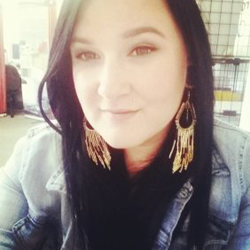 Kayla Lar-Son is a first-year student at the School of Library and Information Studies at the University of Alberta. She is also a proud member of the Metis Nation of Alberta. Currently, Kayla is an Indigenous intern with University of Alberta, Rutherford Library, and is an acting member of the Universities Decolonizing Description working group.
 Lorisia MacLeod is a first-year student at the School of Library and Information Studies at the University of Alberta. She is also an Association of Research Libraries Diversity Scholar and a proud member of the James Smith Cree Nation. Currently, Lorisia works as an Indigenous intern with Rutherford Library at the University of Alberta.
The DERAIL, Diversity, Equity, Race, Accessibility, and Identity in LIS, forum upholds the role of combating white supremacy and oppressive power structures in LIS institutions and pedagogy.
Tanya Ball, Kayla Lar-Son, and Lorisia MacLeod are presenting Raising Indigenous Librarians: Diversity and Professional Development in Academic Libraries on Saturday, March 4, 3:45-4:30 PM Eastern time (that will be 1:45-2:30 PM in Alberta).
The forum will be livestreamed so we can cheer them on as virtual attendees.
Thursday, January 19, 2017
Images of Research 2016 Winner Pony Meyer
Images of Research (IOR), a competition for graduate students to showcase their research in one image, launches for its second year on Monday, January 23, 2017. Last year’s winner, Pony Meyer, was recently featured on the UAlberta home page.
Meyer, who identifies as non-binary, is currently pursuing an Interdisciplinary PhD between the Drama department and Faculty of Physical Education and Recreation. Their winning portrait, entitled “King Me!”, captures the community validation aspect of their research, which explores the role of drag king performance in the lives of transgender/genderqueer drag king performers. The photo was created in collaboration with Katie Cutting of Lazy Kitten Productions and shot with friends who volunteered their time.

“I thought it was a great opportunity to share something about your research in a different way,” said Meyer who thinks the competition has much to offer. “Even creating the written description is good practice for graduate students, to try to make the connection between images and writing.”
Meyer, who hails from Kentucky, U.S., appreciated that the competition was open to international students and that there was a cash prize, which was used to pay for interview transcription services, something that is difficult for them due to chronic pain. Meyer will also use the image as part of their final dissertation along with other images and video links to performances.
Since the first Images of Research Competition and Exhibition was a great success, the University of Alberta Libraries (UAL) and Faculty of Graduate Studies and Research (FGSR) are eager to see the submissions for 2017.
“We were thrilled with the response in 2016, over 100 stunning entries, so we have made the deadline a bit earlier this year to provide even more time for students to prepare and submit their entries,” said Trish Rosseel, Associate University Librarian and one of the organizers. Submissions for IOR 2017 will be accepted from Jan. 23 to Feb. 10, 2017.
Digital image workshops are being offered in collaboration with Campus Design and Print Solutions on January 26 and February 2 to help grad students navigate the technical requirements.
Meyer, who identifies as non-binary, is currently pursuing an Interdisciplinary PhD between the Drama department and Faculty of Physical Education and Recreation. Their winning portrait, entitled “King Me!”, captures the community validation aspect of their research, which explores the role of drag king performance in the lives of transgender/genderqueer drag king performers. The photo was created in collaboration with Katie Cutting of Lazy Kitten Productions and shot with friends who volunteered their time.
“I thought it was a great opportunity to share something about your research in a different way,” said Meyer who thinks the competition has much to offer. “Even creating the written description is good practice for graduate students, to try to make the connection between images and writing.”
Meyer, who hails from Kentucky, U.S., appreciated that the competition was open to international students and that there was a cash prize, which was used to pay for interview transcription services, something that is difficult for them due to chronic pain. Meyer will also use the image as part of their final dissertation along with other images and video links to performances.
Since the first Images of Research Competition and Exhibition was a great success, the University of Alberta Libraries (UAL) and Faculty of Graduate Studies and Research (FGSR) are eager to see the submissions for 2017.
“We were thrilled with the response in 2016, over 100 stunning entries, so we have made the deadline a bit earlier this year to provide even more time for students to prepare and submit their entries,” said Trish Rosseel, Associate University Librarian and one of the organizers. Submissions for IOR 2017 will be accepted from Jan. 23 to Feb. 10, 2017.
Digital image workshops are being offered in collaboration with Campus Design and Print Solutions on January 26 and February 2 to help grad students navigate the technical requirements.
Subscribe to:
Posts
(
Atom
)