
Showing posts with label ejournals. Show all posts
Tuesday, August 29, 2017
Re-discover Academic Journals with BrowZine

In this age of straight-forward Google searches and online shopping, we often forget the power of browsing.
Companies, streaming services and, yes, even libraries are struggling to replicate browsing experiences in the virtual world to reveal their products and content. Within academia in particular, the evermore digital nature of scholarly communication, causes the unfortunate side-effect that we seldom 'browse' the library shelves or flip through complete journals anymore. This is where the BrowZine, a mobile and web-based application, comes in.
BrowZine, is a "journal engagement platform" by library technology company Third Iron that provides the simple service of enabling library users to 'browse' journal content that the libraries subscribes to.
You can download the free apps for several types of mobile platforms or you can access a web-based version on a desktop or laptop. After quickly creating an account with your university email account you can start to fill your virtual shelves with the journals relevant to your field. You can browse by subject matter or input names of specific journals. As journals update content overtime, the BrowZine app notifies you. You can then skim the titles of the articles and save any you wish to read later.
BrowZine also takes you directly to the article PDF version (if the publisher provides one) so you can read it within the app, essentially recreating the 'flipping through a journal' experience. BrowZine will be of most use to faculty and grad students trying to keep up with research publications in specific fields of study.
You can download the free apps for several types of mobile platforms or you can access a web-based version on a desktop or laptop. After quickly creating an account with your university email account you can start to fill your virtual shelves with the journals relevant to your field. You can browse by subject matter or input names of specific journals. As journals update content overtime, the BrowZine app notifies you. You can then skim the titles of the articles and save any you wish to read later.
BrowZine also takes you directly to the article PDF version (if the publisher provides one) so you can read it within the app, essentially recreating the 'flipping through a journal' experience. BrowZine will be of most use to faculty and grad students trying to keep up with research publications in specific fields of study.
Browzine In Action
 |
A snapshot of my BrowZine shelf for
Communication journals.
|
Over the course of several weeks, whenever I had a free moment, I skimmed through my journals in BrowZine.
In a two-week period, I found:
- 8 research articles that I will be including in my literature review,
- 4 articles using relatable research methods,
- and several others that I passed on to other fellow grad students.
I also have a long list of interesting articles unrelated to my research that I want to return to when time permits.
My little trial of BrowZine has proven to me that browsing really does expose you to new ideas and avenues of research you never considered. BrowZine also keeps you abreast of the bigger picture of what is happening in your field by revealing the full contents of specific journal issues, allowing you to see trends in a broader sense.
Monday, November 7, 2016
Using Licensed Electronic Resources
Search the Library and you will find more than just electronic articles and books. You will also learn how you can use and re-use these resources, which are made available to you via licensing agreements negotiated by staff at the University of Alberta Libraries.
As a course instructor you have likely uploaded an article to your learning management system (LMS), such as eClass or uLearn, for your students.
Information about whether or not our license allows this use, as well as others such as inclusion in course packs, downloading, or printing, is available in the “Our Usage Rights” column in catalogue entries (see the screenshot below) or by following the "Get It! ualberta" link.

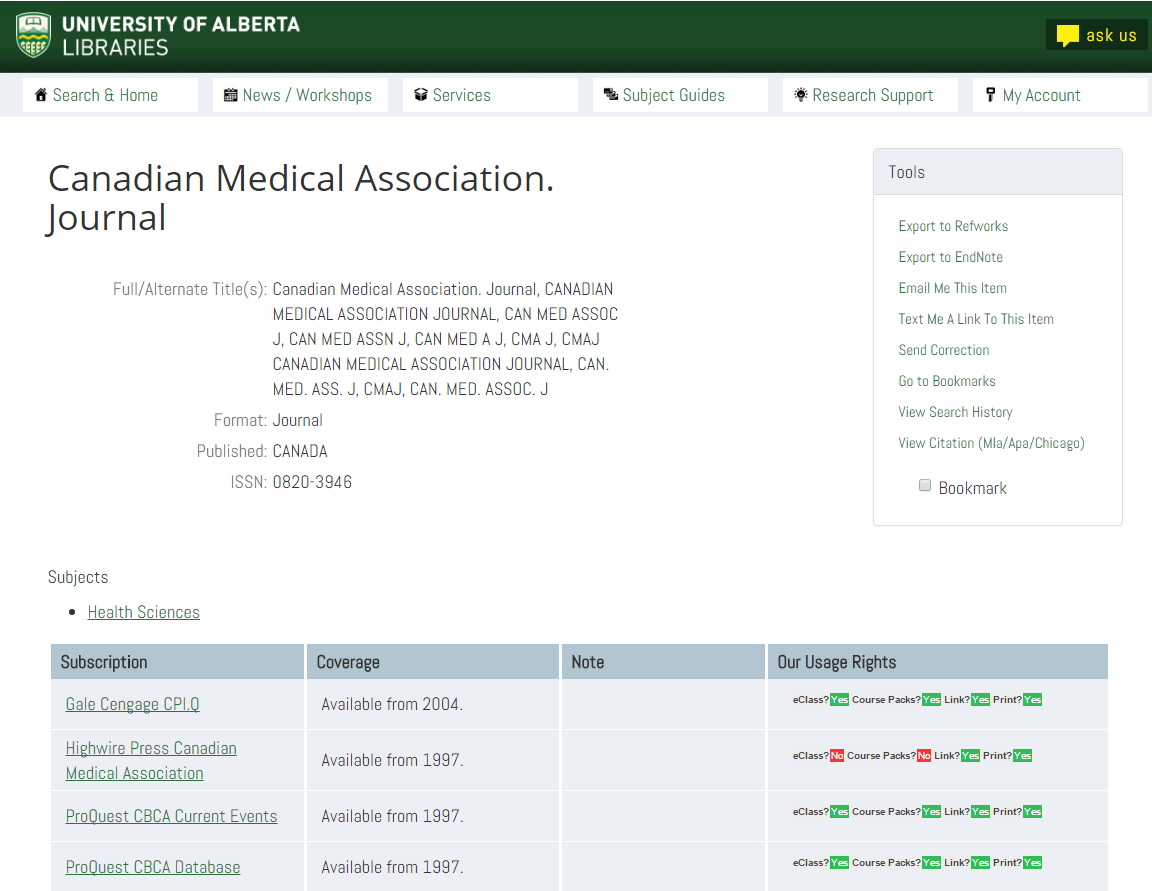
Have more questions about using electronic resources in your classroom and/or making copies of course materials in general? Contact the Copyright Office at copyright@ualberta.ca
As a course instructor you have likely uploaded an article to your learning management system (LMS), such as eClass or uLearn, for your students.
Information about whether or not our license allows this use, as well as others such as inclusion in course packs, downloading, or printing, is available in the “Our Usage Rights” column in catalogue entries (see the screenshot below) or by following the "Get It! ualberta" link.
Looking for ebook usage rights? These are often found in the first few pages of the downloaded material. In addition, the eBook Library Guide provides information about downloading, printing, and saving eBooks made available through major providers: http://guides.library.ualberta.ca/ebooks.
Have questions about the terms of use for a specific database or electronic resources licensed by the University of Alberta Libraries? Contact your subject librarian: https://www.library.ualberta.ca/about-us/staff/subject-librarians
Thursday, July 14, 2016
Over 336,000 People Have Accessed UAlberta's Hosted Open Access Journals! Have You?

Have you accessed any lately?
We host nearly 40 online journals using a popular open source software, Open Journal Systems. Each of our journals are edited and managed independently by diverse groups, such as scholarly societies, research groups, and student associations. They publish articles across a wide range of disciplines, from English to Pharmacy, but all share a common element: their articles are available entirely free of charge, to anyone who wants to read them.
Our journals have attracted readers from countries around the world. Not surprisingly, Canada, the United States, the United Kingdom, and Australia are our most frequent visitors. However, India, Germany, China, South Africa, Brazil, and Indonesia also make the top ten list. Visitors from the Turks and Caicos Islands spend the most time per visit on our site, while visitors from Iran have some of the highest rates of return visits. The only countries not represented are North Korea, and the Central African Republic.
Open access journals can be critical sources of high quality research information for scholars, students, practitioners, and the public, especially those who may lack access to well-resourced libraries or research centres. and we’re pleased to provide our hosting service free of charge to any Canadian journals who commit to making their content open access.
For more information about the UAlberta Libraries free journal hosting service, please contact ojshelp@ualberta.ca.
Thursday, March 24, 2016
Public Knowledge Project Announces UAL as Major Development Partner

The Public Knowledge Project (PKP) is pleased to announce that the University of Alberta Libraries (UAL) have entered into a major development partnership with PKP, furthering a commitment to the development of scholarly communication software. As a result of this agreement, UAL will provide significant financial and in-kind support to assist with PKP’s ongoing development and support of its open source software suite - Open Journal Systems (OJS), Open Monograph Press (OMP), Open Conference Systems (OCS), and Open Harvester System (OHS).
Brian Owen, Associate University Librarian at Simon Fraser University Library and PKP’s Managing Director stated: “The University of Alberta Libraries are a real powerhouse with their contributions to a wide variety of open source projects in the library community both in Canada and elsewhere. PKP is looking forward to working closely with UAL staff on a number of initiatives.”
“We are excited to take the relationship between PKP and UAL to the next level. Leveraging our shared knowledge to improve open source publishing environments is an opportunity too great not to take advantage of it” commented Geoff Harder, Associate University Librarian for Digital Initiatives at the University of Alberta Libraries.
UAL will be working with PKP on the following areas in the coming years:
- user interface/user experience review and testing for the all new version of OJS 3.0
- specific software enhancements such as digital object identifer (DOI) support
- OJS journal hosting deployment strategies
- article level metrics
“This partnership creates a wonderful opportunity for PKP to tap into UAL’s leadership in library systems and scholarly communication,” said John Willinsky, PKP’s founding director and Stanford professor, “with benefits for the larger academic community and the public, as well, through the expansion of open access.”
“PKP’s mission and global reach aligns perfectly with UAL’s own commitment to the creation of an open, sustainable and responsive environment for scholarly communications” added Gerald Beasley, Vice-Provost (Learning Services) and Chief Librarian.
- Visit the UAL journal hosting site to view currently OJS-hosted journals and get information about using this service
- Read more about The Public Knowledge Project
Subscribe to:
Posts
(
Atom
)