
Showing posts with label BPSC. Show all posts
Monday, January 20, 2020
Two ways to study a mysterious manuscript: new workshop at BPSC
Written by Hanne Pearce

Bruce Peel Special Collections has recently acquired a hand-made replica of the Voynitch Manuscript. According to Special Collections Librarian, Linda Quirk, “The Voynitch is one of the most studied and most mysterious of all manuscripts. There has been a lot of interest in getting a well-made facsimile so that faculty and students around the world can go to their own university library to see and experience it for themselves. Like other good quality facsimiles, this one is designed to replicate the original in every sense. It looks and feels and sounds and smells like the original because it is a full-size and full-colour reproduction, bound in the same manner and printed on the same material at the original, i.e. vellum. Vellum is made from animal skin and was routinely used for manuscripts and early printed books before paper eventually displaced it. Produced by a respected fine-art facsimile publisher in 2018, this one was published in a limited edition of 898 copies.”
This new workshop also offers a unique experience for participants, by presenting two scholar’s perspectives on the manuscript, from very different fields of study. English professor John Considine presented a historical and critical analysis of the provenance and contents of the manuscript. Accepting the 1404-1438 carbon-dating of the vellum pages, Considine looks closer at the illustrations and overall composition of the manuscript to infer potential areas of origin and possible subjects of the work. Comparing illustrations, book genres of the time and known authors who created similar works Considine offers a number of potential purposes.
Bradley Hauer, a Ph.D. student in computing science, and Professor Greg Kondrak of computing science present a second approach to Voynitch. Hauer’s research interests include identifying languages with artificial intelligence. He explained how deciphering the Voynich Manuscript is exponentially challenging. Aside from being unable to read the encrypted script of the manuscript or identify the original language, previous analyses of the Voynitch show that the text must also be intentionally encoded. This means that the script is unknown to us, the language is unknown to us, and the order of the letters in the words have been systematically scrambled in some way. Using the analyses of older European languages, his team used algorithms to analyze the Voynich Manuscript to try and determine its language.
This workshop reveals an intriguing manuscript, that the University community can now engage with better because of our facsimile. It also demonstrates the usefulness of both human reason and artificial intelligence, and how the two working together may be the way to formulating new understandings.
To register for this and other Peel Workshops, find more information here.

Friday, March 22, 2019
How Have Our Photos Changed Since the 19th Century?
I immediately signed up for “19th century photographic prints” as I am a freelance photographer outside my work at the library. I’ve always been intrigued by old photographs as they reveal unspoken aspects about life in a different time.
We live in an era where the digital photograph has made photographs mundane everyday tools. We snap selfies of ourselves in the mornings when we’re having a particularly good hair day, we shoot funny things we witness on our way to school or work and the every-day electronic exchange of photos can make us take them very much for granted. How often do we look at our photos and how many of them become forgotten on our devices? In a world full of photos, it is difficult to conceptualize a time when photographs did not exist.
One of my favourite reads of the past year was Capturing the light : the birth of photography, a true story of genius and rivalry by Roger Watson and Helen Rappaport. The book details the haphazard history of how photography was invented and the many players (Niépce, Daguerre and Henry Fox Talbot to name a few) that played a role in its development. With these ideas on my mind lately, I was quite excited when I saw the workshop on 19th century photographs workshop as an opportunity to learn from experts about how photography was practiced in the past, and to actually see examples of the different types of prints in person.
Bruce Peel Special Collections Conservator Carolyn Morgan lead the session which showcased many different types of early photographs. Starting with early Daguerreotypes, Ambrotypes, to Tintypes, Carolyn explained the processes by which these different types of prints were created.
One of my favourite reads of the past year was Capturing the light : the birth of photography, a true story of genius and rivalry by Roger Watson and Helen Rappaport. The book details the haphazard history of how photography was invented and the many players (Niépce, Daguerre and Henry Fox Talbot to name a few) that played a role in its development. With these ideas on my mind lately, I was quite excited when I saw the workshop on 19th century photographs workshop as an opportunity to learn from experts about how photography was practiced in the past, and to actually see examples of the different types of prints in person.
Bruce Peel Special Collections Conservator Carolyn Morgan lead the session which showcased many different types of early photographs. Starting with early Daguerreotypes, Ambrotypes, to Tintypes, Carolyn explained the processes by which these different types of prints were created.
Laid out on the tables in the Peel Library these photos, most of which were portraits, all exhibited different features depending on the processes that were used to create them. Some were dark and very detailed, others were faint or looked almost like drawings rather than photographs.
One of the key things I learned is that Daguerreotypes were printed on a sheet of silver plated copper, and they can easily be identified by their mirror-like surface. Daguerreotypes as were often encased in a frame to prevent tarnish.
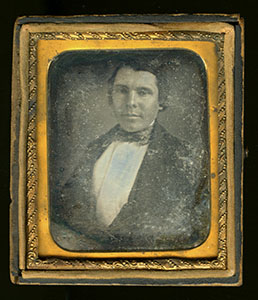 |
| Daguerreotype example |
One of the key things I learned is that Daguerreotypes were printed on a sheet of silver plated copper, and they can easily be identified by their mirror-like surface. Daguerreotypes as were often encased in a frame to prevent tarnish.
 |
| Tintype example |
Later Tintype photos were imprinted onto iron plates (metal) and Ambrotype were on glass with a dark paper or material backing.
 |
| Ambrotype example |
The workshop reinforced how early photography was expensive and only really the wealthy could really afford to have photos taken. It also revealed to me how one of my favourite past times was once heavily linked with chemistry and chemical processes.
I often wonder what the earliest photographers would think about how we now snap pictures of our food to disseminate with everyone we know, or text shots of store shelves as information to a friend or partner who is not present. Even though our digital equivalents manifest instantly and can be sent across the world in seconds, our photos still reveal details of our lives and are very much a part of the history photography. I only hope someday hundreds of years from now, people will be able to view them with the same fascination as we view early photographs.
Look for upcoming Bruce Peel workshops you can go to the library workshop page and filter the sessions for just Bruce Peel Special Collections.
You can also read more about 19th Century Photography in books from our collection.
I often wonder what the earliest photographers would think about how we now snap pictures of our food to disseminate with everyone we know, or text shots of store shelves as information to a friend or partner who is not present. Even though our digital equivalents manifest instantly and can be sent across the world in seconds, our photos still reveal details of our lives and are very much a part of the history photography. I only hope someday hundreds of years from now, people will be able to view them with the same fascination as we view early photographs.
Look for upcoming Bruce Peel workshops you can go to the library workshop page and filter the sessions for just Bruce Peel Special Collections.
You can also read more about 19th Century Photography in books from our collection.
Friday, August 17, 2018
Bruce Peel Special Collections wins UCDA Awards: a hat trick!
Bruce Peel Special Collections received wonderful news that judges of the annual University & College Designers Association (UCDA) Design Competition have chosen three of the Peel library's recently published exhibition catalogues for an Award of Excellence.
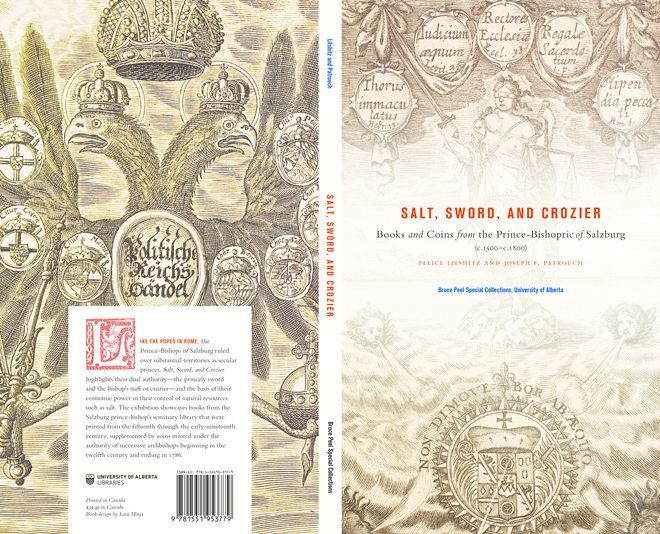
Designer: Lara Minja (Lime Design)
Editorial: Cheryl Cundell
Exhibition Design: Kevin Zak
Photography: Kevin Zak & Louise Asselstine
Special Assistance: Linda Quirk, Jesse Carson, Robin Chorzempa, Paul Gifford, Carolyn Morgan, Jeff Papineau, Michaela Stang, Sara Tokay
Managing Editor: Robert Desmarais

Designer: Natalie Olsen (Kisscut Design)
Editorial: Cheryl Cundell,
Exhibition Design: Kevin Zak
Research & Editing Support: Linda Quirk, Jesse Carson, Samantha Nugent
Copyright Consultation: Adrian Sheppard
Special Assistance: Paul Gifford, Michaela Stang, Carolyn Morgan
Digital Reproduction: Jeff Papineau, Kevin Zak
Managing Editor: Robert Desmarais
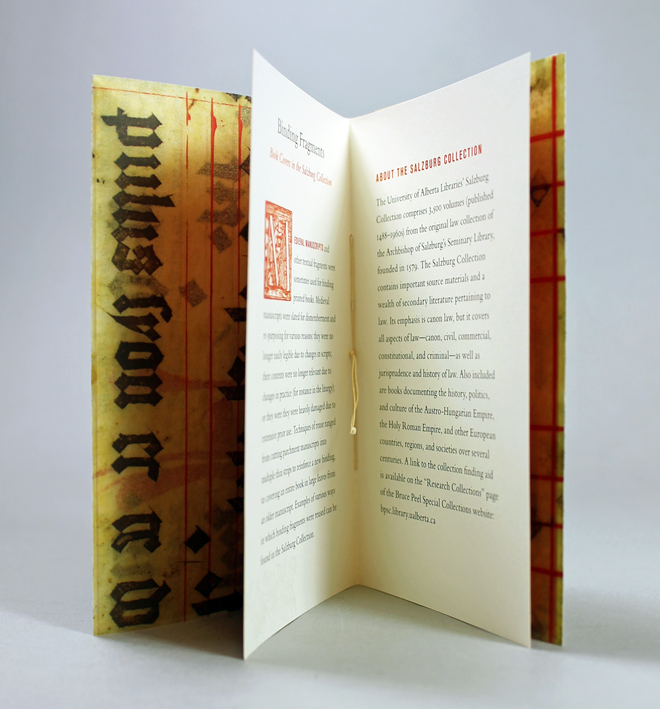
Designer: Sergio Serrano
Design Director: Kevin Zak Special Assistance: Michaela Stang
Managing Editor: Robert Desmarais
The judges evaluated 1,060 print and digital entries for excellence in design, illustration, concept, typography, printing, and overall message; and in this year's competition, they awarded 5 Gold Awards, 12 Silver Awards, and 198 Awards of Excellence.
The award-winning publications will be on display at the 2018 UCDA Design Conference in Grand Rapids, Michigan from September 29 to October 2, where the winners will be recognized with certificates.
"I commend our catalogue designers and Exhibitions & Collections Assistant Kevin Zak for their fine work, as well as the entire publication team (noted below) for their commitment to excellence." says Robert Desmarais, Special Collections Librarian and Head of Bruce Peel Special Collections.
Salt, Sword, and Crozier: Books and Coins from the Prince Bishopric of Salzburg (c.1500-c.1800) by Felice Lifshitz and Joseph F. Patrouch
Credits:Designer: Lara Minja (Lime Design)
Editorial: Cheryl Cundell
Exhibition Design: Kevin Zak
Photography: Kevin Zak & Louise Asselstine
Special Assistance: Linda Quirk, Jesse Carson, Robin Chorzempa, Paul Gifford, Carolyn Morgan, Jeff Papineau, Michaela Stang, Sara Tokay
Managing Editor: Robert Desmarais
Experiment: Printing the Canadian Imagination by David McKnight
Credits:Designer: Natalie Olsen (Kisscut Design)
Editorial: Cheryl Cundell,
Exhibition Design: Kevin Zak
Research & Editing Support: Linda Quirk, Jesse Carson, Samantha Nugent
Copyright Consultation: Adrian Sheppard
Special Assistance: Paul Gifford, Michaela Stang, Carolyn Morgan
Digital Reproduction: Jeff Papineau, Kevin Zak
Managing Editor: Robert Desmarais
Binding Fragments: Book Covers in the Salzburg Collection by Felice Lifshitz and Joseph F. Patrouch
Credits:Designer: Sergio Serrano
Design Director: Kevin Zak Special Assistance: Michaela Stang
Managing Editor: Robert Desmarais
Tuesday, August 22, 2017
Bruce Peel Library Receives Design Award
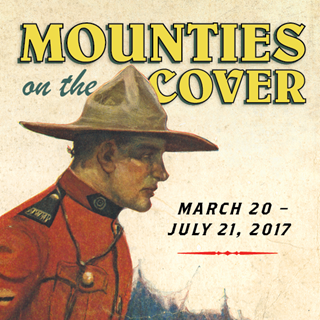
Mounties on the Cover (UAL, 2017) won an Award of Excellence from the annual UCDA Design Competition in the exhibition publication category. Lara Minja from Lime Design created a beautiful publication and curator Al Lund selected a delightful array of book covers for the exhibition and catalogue layout.
Copies of the exhibition catalogue can be purchased through University of Alberta Press, Indigo, Amazon, or in person in the Peel library.
If you did not get an opportunity to see the exhibition, you are always welcome to submit a Retrieval Request Form to have a look. Simply request selections from the exhibition of the RCMP Book Collection of S/Sgt. Al Lund to view in our reading room.
Patrons are also encouraged to look at catalogued material from the RCMP Book Collection of S/Sgt. Al Lund, which can be searched by typing "RCMP Book Collection" in the library catalogue.
We look forward to your visit!
Patrons are also encouraged to look at catalogued material from the RCMP Book Collection of S/Sgt. Al Lund, which can be searched by typing "RCMP Book Collection" in the library catalogue.
We look forward to your visit!
Subscribe to:
Comments
(
Atom
)


