
Showing posts with label faculty. Show all posts
Wednesday, September 11, 2019
What are your librarians up to? Turns out, it’s a lot of teaching!
course instruction
,
faculty
,
subject librarians
,
Teaching Library
,
teaching support
No comments
:
This is a guest post by librarians, Jessica Thorlakson and Janice KungThe University of Alberta Libraries (UAL) is a strong supporter of teaching and information literacy. In 2018, your library staff taught approximately 667 sessions with approximately 17,542 library users. That’s a lot of people!
 |
| Image by rawpixel from Pixabay |
One of the best ways to do this is through the collaboration between professors/instructors and subject librarians. Librarians come into classes and provide relevant library and information literacy instruction that are customized to meet the learning outcomes of the course. These are “course based” instructional sessions and can cover everything from effectively searching databases for literature, citation manager tools, research metrics, research data management, and more.
However, UAL also offers many “non-course based” instructional sessions, those not connected to specific UAlberta courses. These provide additional opportunities to pick up other information literacy skills or additional topics relevant to research or campus life, such as how to manage a unique identifier for your researcher profile (e.g. ORCID), identifying predatory publishers, and systematic review searching.
In the visualizations below, you can see some of our instruction statistics from 2013-2018.

The fall term sees the largest influx of new students, so naturally it is the library’s busiest month for instruction, as we reach out to our users and provide an orientation about our services and resources. While much of our instruction is considered “course based” (in fact, 72% of all library instruction is embedded within the curriculum), the non-course based sessions offer greater flexibility so the library can provide more in-depth sessions on a variety of topics, such as the monthly three-hour training sessions on systematic review searching.
We look forward to another busy, library instruction year with all of you. If you are looking for some library instruction for your class, try contacting your subject librarian.
Thursday, February 28, 2019
How you can Celebrate Open Education Week 2019!

Every year the first week of March means it is time to celebrate Open Education Week!
Open educational resources (OER) are any freely available teaching, learning or research material. The possibilities for OERs are endless and they can include videos, podcasts, presentations and even textbooks. OERs provide the flexibility to share, collaborate and draw on course materials from around the world, while reducing the cost of higher education by challenging expensive textbook prices. OERs also provide a practical and effective way to facilitate lifelong learning, an essential skill in our changing and complex world.
We know this is a busy time for everyone on our campus, so we thought we would share some ways that you can get the scoop on Open Education around your hectic schedule.
Here are some ways you can celebrate Open Education Week 2019:
Learn what the University of Alberta Libraries has to offer all year
Did you know we have a guide for finding and learning about OER? and publishing program for OER? Check out these pages without worrying about committing time to attending an event.See what global Open Education Week has to share
www.openeducationweek.org has events from around the world on any topic that interests you. If you are unsure where to start, we might suggest this webinar on adopting open practices, this webinar on making sense of open education, or the Global Open Education Web Conference.Join a Wikipedia Edit-a-thon
Attending a lecture isn't for everyone, for those what prefer active involvement, why not join a Wikipedia Edit-a-thon? March 4, from 1-4pm PST the Institute for Critical Indigenous Studies, with support from UBC Library and the Centre for Teaching and Learning Technology, and the First Nations House of Learning, will be hosting an Indigenous Literature Wikipedia Edit-a-thon. You can also join online via this link.Look for Opportunities to Learn
There are opportunities to learn about Open Education all year. For example, join us on March 22 for a workshop on finding OER for teaching. Follow this link for more details!
Tuesday, February 19, 2019
New York Times Digital - Now at UAlberta

The University of Alberta Libraries are pleased to provide digital access to the New York Times! But what does this mean? The libraries already provide access to the NY Times in print and to historical content online.
With digital access, you can keep up with the current news cycle and access other great online features:
- The New York Times app for mobile devices
- NYT Cooking app (over 17K recipes that can be saved and accessed across platforms)
- NYT VR app - experience (with a virtual reality viewer) some NY Times content in 3D
- The Daily 360 - two dimensional videos that provide 360° views (with mobile device or mouse)
- Interactive media (graphics, charts, maps, polls, custom content)
- Video library (spanning all sections)
- Augmented reality content (requires an iPhone 6S or higher)
- Newsletters (there are a variety of topics that you may subscribe to)
- Article history and save options (across platforms)
- Article comment permissions
- New York Times inEducation (includes 16 discipline-specific areas of study, discussion prompts, learning outcomes, instructional strategies, and co-curricular activities)
What is not included with our NY Times academic license:
- E-reader editions
- Times Insider
- Premium Crosswords
- New York Times Crossword app (app is free to download, but requires in-app purchase to access Premium Crosswords)
To activate your access:
- Register for nytimes.com using your UofA email address.
- Register for nytimesineducation.com using your UofA email address.
- Download your NYT mobile app from nytimes
After registration you can enjoy access to NYTimes.com from any network or location.
Friday, February 1, 2019
Now Open! Library Publishing for Open Textbooks
faculty
,
graduate students
,
OER
,
OJS
,
open access
,
services
No comments
:

OER are teaching and learning materials that are accessible without cost and allow for free use, reuse and redistribution. OER often have a Creative Commons license that states specifically how the material may be used, reused, adapted, and shared.
If you are interested in creating, adapting or using open textbooks or other OER in a course, the Libraries’ can provide you with the tools, expertise, and free hosting to get you started.
For more information, see www.library.ualberta.ca/publishing or contact library.publishing@ualberta.ca to see if our service is the right match for your learning materials. You can also check out the OER Awards, to see if you are eligible to apply for additional support for your project.
Friday, October 5, 2018
Open Access Week 2018
Here are a few local events you can attend! Find many more on the global 2018 OA Week Calendar, or follow #openaccessweek2018 on Twitter.
Monday, October 22
11:00 AM -12:00 PM, Senate Chamber (326 Arts and Convocation Hall)
Has the Open Access Movement Ossified? What Gains Remain to be Had and What Work Needs to be Done
As the 10th annual Open Access (OA) week begins, it is important to not just celebrate the gains made but also interrogate what the future holds for the OA movement.
Michael B. McNally from the School of Library and Information Studies will argue that with many substantive gains already made, from the adoption of OA in various funding models to the emergence (and capture) of OA as business model for scholarly publishing, that the OA movement has evolved into an increasingly ossified movement. The dream of OA as the mode for scholarly communication is dead.
Michael B. McNally from the School of Library and Information Studies will argue that with many substantive gains already made, from the adoption of OA in various funding models to the emergence (and capture) of OA as business model for scholarly publishing, that the OA movement has evolved into an increasingly ossified movement. The dream of OA as the mode for scholarly communication is dead.
Dale Askey, Vice-Provost and Chief Librarian, will respond to the presentation and provide his insights on what the future of scholarly publishing holds and what this means for advocates OA advocates. After the presentation and response there will be time for questions and discussion with the audience.
Registration now open!
3:30 PM - 5:00 PM
Documentary Screening: Paywall the Business of Scholarship

Join us at MacEwan University
Wednesday, September 19, 2018
Research Computing Bootcamp - Sept 24-28
digital initiatives
,
digital scholarship
,
faculty
,
graduate students
,
research data management
,
research impact
,
researchers
No comments
:
Join in Research Computing Fall Bootcamp events beginning September 24!
Patrick Mann, Director of Operations at WestGrid, kicks off a week full of research computing activities with valuable tips for writing a research allocation proposal. Mann’s areas of focus include cloud computing, virtualization, networking, systems architecture, system administration, and collaboration.
Additional events will run through September 28 and include a marketplace, one-on-one consultations, workshops on Shell, Regex, OpenRefine, and more!
Sign-up for Fall Bootcamp events running September 24 - 28 here: https://ist.ualberta.ca/blog/events/get-ready-research-computing-fall-bootcamp
Fall Bootcamp provides the opportunity to connect with colleagues and research computing experts to share knowledge and best practices. Research Computing Fall Bootcamp is held in collaboration with University of Alberta Libraries and Information Services & Technology (IST).
Monday, June 25, 2018
Five Ways Browzine Will Revitalize Your E-Journal Experience
 Have you tried Browzine yet? If not, you’re missing out on a fantastic way to stay up-to-date on all your favourite journals wherever you have a network connection. Best of all, Browzine offers free apps for a plethora of desktop and mobile devices, meaning all current University of Alberta students, faculty and staff can take advantage of all Browzine has to offer. Here’s five more reasons you should be using Browzine:
- Planning on sitting back with the latest issue of your favourite journal? Browzine’s simple bookshelf interface gives you the ability to view single articles and full issues of journals.
- Curious about what other journals are available in your area of interests? You can browse an incredible array of journals available through UAlberta libraries and open access publishers using Browzine.
- Do you eagerly await the release of the latest issues of your favourite titles? You can save your favs to your personal bookshelf and get alerts when new issues are published.
- Headed somewhere where there’s no internet access? You can save articles to your mobile device for offline viewing.
- Discover an article that complements your research? You can easily export the article’s reference data into the reference manager of your choice.
Monday, January 15, 2018
Interlibrary Loan Survey
The University of Alberta Libraries is conducting an online survey regarding our Interlibrary Loan Services, and we would love to hear from you!

Your feedback will give us valuable insight into how our services can be improved, as well as address any concerns that users currently have while requesting Interlibrary Loan material. The survey will remain open until February 7, 2018.
To complete this survey, please follow the link below:
https://libraryualberta.ca1.qualtrics.com/jfe/form/SV_9KRgDT4IwLrtkLb
If you have any questions regarding this survey, please contact Victoria Wong at vlwong@ualberta.ca, or at 780-492-7905.
Tuesday, January 31, 2017
Instructors: Course Readings at Your Students' Fingertips!

Send the library your course reading list and we will provide you with durable links to online articles and ebooks. You can use these links in eClass and on course websites so your students will have easy access to class readings. Usually, some ebooks may only be accessed by a limited number of people at a time but when you use this service, we raise user limits on e-books for course readings.
Also, at your request, we will add print items to the library reserve room of your choice that students may borrow for short term loans.
The library already has many required textbooks available in our reserve rooms through a partnership with the Bookstore. If your course text needs to be added please include it in your request.
And, as always, Ask Us if you have questions!
Monday, November 7, 2016
Using Licensed Electronic Resources
Search the Library and you will find more than just electronic articles and books. You will also learn how you can use and re-use these resources, which are made available to you via licensing agreements negotiated by staff at the University of Alberta Libraries.
As a course instructor you have likely uploaded an article to your learning management system (LMS), such as eClass or uLearn, for your students.
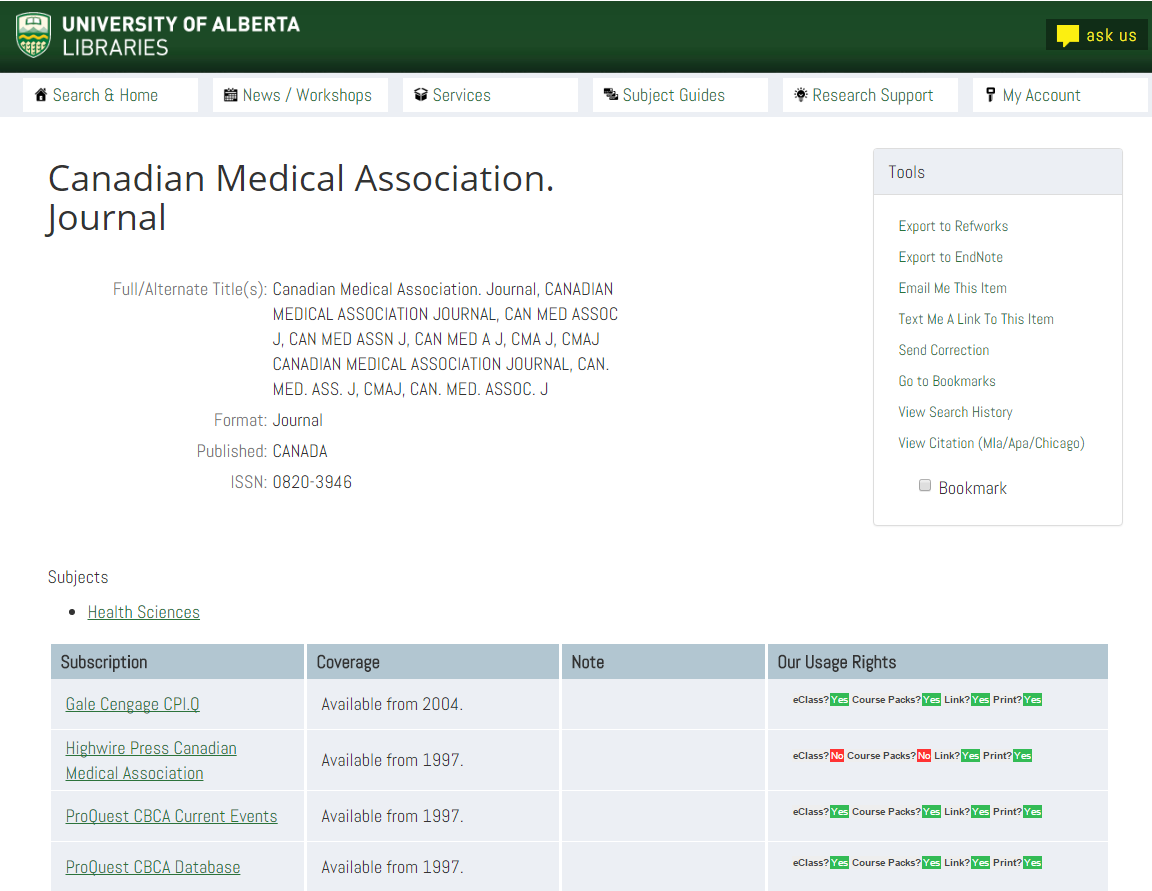
Information about whether or not our license allows this use, as well as others such as inclusion in course packs, downloading, or printing, is available in the “Our Usage Rights” column in catalogue entries (see the screenshot below) or by following the "Get It! ualberta" link.

Have more questions about using electronic resources in your classroom and/or making copies of course materials in general? Contact the Copyright Office at copyright@ualberta.ca
As a course instructor you have likely uploaded an article to your learning management system (LMS), such as eClass or uLearn, for your students.
Information about whether or not our license allows this use, as well as others such as inclusion in course packs, downloading, or printing, is available in the “Our Usage Rights” column in catalogue entries (see the screenshot below) or by following the "Get It! ualberta" link.
Looking for ebook usage rights? These are often found in the first few pages of the downloaded material. In addition, the eBook Library Guide provides information about downloading, printing, and saving eBooks made available through major providers: http://guides.library.ualberta.ca/ebooks.
Have questions about the terms of use for a specific database or electronic resources licensed by the University of Alberta Libraries? Contact your subject librarian: https://www.library.ualberta.ca/about-us/staff/subject-librarians
Tuesday, February 16, 2016
Celebrate Open Education Week

Open educational resources (OERs) are any freely available material or media that facilitates teaching and learning. OERs can include videos, podcasts, presentations, textbooks and more. They provide faculty the flexibility to share, collaborate and draw on course materials from around the world, while reducing the cost of higher education by challenging expensive textbook prices. OERs also provide a practical and effective way to facilitate lifelong learning, an essential skill in our changing and complex world.
Attend the University of Alberta’s Open Education Week events to learn more about OERs and what they mean for you.
Planned sessions include:
- Webinar with Cable Green, Director of Global Learning at Creative Commons
- Keynote lecture and hands-on workshop with Rajiv Jhangiani, Faculty, Kwantlen Polytechnic University and OER Research Fellow, Open Education Group
- Webinar with Dr Janet Welch on the Campus Alberta OER Initiative
- Panel with faculty and students on efforts to open up course textbooks at UAlberta
- Visit the Libraries' Open Educational Resources Guide guide
- Join the University of Alberta Open Education community listserv
- Apply for funding through the Campus Alberta Open Educational Resources Initiative
- Follow @uofalibraries to contribute to the Open Education Week conversation with the #uaopened hashtag
Wednesday, October 14, 2015
Start your research odyssey with odesi

<odesi> gathers data from a number of sources. You have the option to search across all data sets, or to narrow your focus to certain collections, which include:
- Statistics Canada: Public-use microdata files (PUMFs) and aggregate data products made available to subscribers of the Data Liberation Initiative (DLI). Data includes socio-economic indicators, business and financial databases, census microdata and aggregate data, social surveys, education, crime, health, and more.
- Public Opinion Polls: Historical Canadian public opinion polling data from Gallup.
- Other Canadian Data: Studies from other Canadian data sources, including the Canadian Millenial Scholarship Foundation, the Canadian Policy Research Network, and the Institute for Social Research.
- CORA: Researcher data and surveys from the Canadian Opinion Research Archive.
- ICPSR: Metadata from the Interuniversity Consortium for Political and Social Research. Note that while the metadata is available to everyone through <odesi>, only some schools will have access to the actual data files. These must be accessed through the ICPSR website. Links are provided where possible.
<odesi> is always expanding its survey data to include other national and international data sources.
<odesi> can be used for all types of research; some example topics include education, health, the environment, social, and economic well-being of populations within Canada and abroad. In <odesi> it is possible to build charts, tables, look at trends over time, and produce correlations.
- Access <odesi> through the University of Alberta Libraries web site.
- Request an appointment with one of the members of our Data Library to get help using <odesi>.
Tuesday, September 22, 2015
Ithaka Faculty Survey Key Insights and Opportunities

A key goal of the survey is to provide evidence-based strategic insights into how faculty members perceive the role of the Libraries and identify areas of opportunity for innovation. The results from the survey revealed the following strategically relevant key insights and opportunities.
Key Insights
- In general, a substantial share of faculty value the library's role in serving as a gateway for the discovery of scholarly content
- Across all disciplines, faculty view the library's role as a purchaser of collections as critical to their ability to conduct research
- Arts and humanities faculty highly value and recognize the library’s role in providing access to needed research materials and scholarly content, and in the provision of research and teaching-related support for students in developing research and information literacy skills
- Faculty in the medical/veterinary/health science and science disciplines are much more likely to prefer only electronic versions of scholarly resources including monographs and journal articles, when compared with their colleagues in the arts, humanities, and social sciences
- In general, respondents value the library’s role in providing access to subscription-based online repositories of research data, indicating that faculty members may value specialized research content and collections in addition to access to traditional literature
Strategic Opportunities
- To focus on enhancing engagement among faculty members in science disciplines regarding library-provided research and instructional support services
- To enhance strategic communications or targeted outreach to faculty members in medical/veterinary/health science and arts and humanities disciplines specifically regarding how the Libraries can support faculty in organizing, managing, and preserving
- To continue to develop services surrounding the curation of data
For Further Information
- Review the University of Alberta - Analytical Memo for the full narrative of insights and opportunities
- Review the University of Alberta Faculty Survey: Report of Findings, Faculty Survey Feedback, and the Libraries Response to Feedback
- Visit our Research Data Management web site to learn how to organize, access, share, and archive your data
Tuesday, June 16, 2015
Participate in Libraries Usability Testing and Focus Groups

University of Alberta Libraries has launched beta versions of its new website and search tool, which will be fully implemented in the next academic year. In an effort to ensure these new search tools meet the distinct needs of our diverse user community, we invite you to participate in upcoming usability testing and focus groups.
Undergraduate & Graduate Students
- Register for a 30-45 minute one-to-one meeting with one of our usability testers between Thursday, June 25th, and Friday, July 10th
- Participants will be asked to complete a set of tasks using the Libraries' website and search tool
- Date and time will be confirmed with you via email
Graduate Students
- Register for this focus group to provide input regarding your search starting points, needs, and questions
- Date & Time: Wednesday, July 8, 2015, 10am-Noon
- Location: Cameron Library, Room 4-02
- Registration will be limited to 15 participants
- Refreshments will be provided
Faculty
- Register for a focus group to hear feedback on search tools from the Ithaka Faculty Survey, and provide input regarding your search starting points, needs, and questions
- Dates & Times: Tuesday, July 7, 2015, 1-3pm and Thursday, July 9, 2015, 10am-Noon
- Location: Cameron Library, Room 4-02
- Registration will be limited to 15 participants
- Refreshments will be provided
Tuesday, June 2, 2015
Publication and Research(er) Metrics in the Humanities and Social Sciences
The University of Alberta Libraries, in partnership with the Office of the Vice-President's (Research) University of Alberta Grant Assist Program, will be offering a series of sessions and workshops on Publication and Research(er) Metrics in the Humanities and Social Sciences throughout the month of June to Arts faculty and graduate students.
The following workshops will be offered:
Overview of Publication and Research(er) Metrics in the Humanities and Social Sciences
June 9, 2015, 10:30am – 12pm
Rutherford South 2-03

Google Scholar for Metrics
June 12, 2015, 12 - 12:50pm
Rutherford South 2-03
Social Science Research Network (SSRN)
June 15, 2015, 12 - 12:50pm
Rutherford South 2-03
Web of Science and Scopus
June 19, 2015, 12 - 12:50pm
Rutherford South 2-03
Mendeley
June 24, 2015, 12 - 12:50pm
Rutherford South 2-03
Academia.edu and ResearchGate: Sharing, Monitoring, and Following Research
June 26, 2015,12 - 12:50pm
Rutherford South 2-03
For more information, and to register go to: http://bit.ly/MetricsHSS.
Tuesday, May 19, 2015
Ithaka Faculty Survey Results Now Available

- Data Preservation and Management
- Discovery
- Role of the Library
- Student Research Skills
- Digital Research Activities
- Formats
- Market Research
The survey results are now available below. These survey findings will have great value to our institution in tracking how scholarly practices and attitudes are evolving. They also confirm many of our current directions, and will help us to develop and implement strategies for supporting faculty needs in a rapidly changing environment.
- Read the University of Alberta Faculty Survey: Report of Findings
- Read the Faculty Survey Feedback
- Read the UAL Response to Feedback
- Share your feedback on the faculty survey results and response with us
- Visit the Ithaka S + R web site to learn more about the survey and to view previous survey results
Monday, March 23, 2015
Tri-Council Open Access Policy on Publications Announced
The Government of Canada recently announced a new Tri-Agency Open Access Policy on Publications. The objective of this policy is to improve access to the results of research funded by the Canadian Institutes of Health Research (CIHR), the Natural Sciences and Engineering Research Council of Canada (NSERC) and the Social Sciences and Humanities Research Council of Canada (SSHRC), and to increase the dissemination and exchange of research results.
This policy applies to peer-reviewed journal publications that are the product of Tri-Council agency-supported research, and requires that these publications be made freely accessible to the public via the Internet within 12 months of publication. For CIHR funded research only, the policy also applies to publication related research-data.
Tri-Council grant recipients may comply with this new policy by either publishing in journals that make articles openly accessible or by archiving their publication in open access repositories. The University of Alberta Libraries offers services that support both options. Check out the below links for more information.
- Read UofA's Colloquy post on the policy
- Review the Tri-Agency Open Access Policy and related FAQs
- Visit ERA: Education & Research Archives, University of Alberta's institutional repository
- Find out more about University of Alberta Libraries Journal Hosting service
- Contact your liaison librarian for information on upcoming faculty sessions about open access publishing options
Subscribe to:
Posts
(
Atom
)


