
Showing posts with label peel. Show all posts
Friday, March 22, 2019
How Have Our Photos Changed Since the 19th Century?
I immediately signed up for “19th century photographic prints” as I am a freelance photographer outside my work at the library. I’ve always been intrigued by old photographs as they reveal unspoken aspects about life in a different time.
We live in an era where the digital photograph has made photographs mundane everyday tools. We snap selfies of ourselves in the mornings when we’re having a particularly good hair day, we shoot funny things we witness on our way to school or work and the every-day electronic exchange of photos can make us take them very much for granted. How often do we look at our photos and how many of them become forgotten on our devices? In a world full of photos, it is difficult to conceptualize a time when photographs did not exist.
One of my favourite reads of the past year was Capturing the light : the birth of photography, a true story of genius and rivalry by Roger Watson and Helen Rappaport. The book details the haphazard history of how photography was invented and the many players (Niépce, Daguerre and Henry Fox Talbot to name a few) that played a role in its development. With these ideas on my mind lately, I was quite excited when I saw the workshop on 19th century photographs workshop as an opportunity to learn from experts about how photography was practiced in the past, and to actually see examples of the different types of prints in person.
Bruce Peel Special Collections Conservator Carolyn Morgan lead the session which showcased many different types of early photographs. Starting with early Daguerreotypes, Ambrotypes, to Tintypes, Carolyn explained the processes by which these different types of prints were created.
One of my favourite reads of the past year was Capturing the light : the birth of photography, a true story of genius and rivalry by Roger Watson and Helen Rappaport. The book details the haphazard history of how photography was invented and the many players (Niépce, Daguerre and Henry Fox Talbot to name a few) that played a role in its development. With these ideas on my mind lately, I was quite excited when I saw the workshop on 19th century photographs workshop as an opportunity to learn from experts about how photography was practiced in the past, and to actually see examples of the different types of prints in person.
Bruce Peel Special Collections Conservator Carolyn Morgan lead the session which showcased many different types of early photographs. Starting with early Daguerreotypes, Ambrotypes, to Tintypes, Carolyn explained the processes by which these different types of prints were created.
Laid out on the tables in the Peel Library these photos, most of which were portraits, all exhibited different features depending on the processes that were used to create them. Some were dark and very detailed, others were faint or looked almost like drawings rather than photographs.
One of the key things I learned is that Daguerreotypes were printed on a sheet of silver plated copper, and they can easily be identified by their mirror-like surface. Daguerreotypes as were often encased in a frame to prevent tarnish.
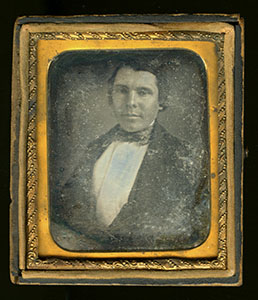 |
| Daguerreotype example |
One of the key things I learned is that Daguerreotypes were printed on a sheet of silver plated copper, and they can easily be identified by their mirror-like surface. Daguerreotypes as were often encased in a frame to prevent tarnish.
 |
| Tintype example |
Later Tintype photos were imprinted onto iron plates (metal) and Ambrotype were on glass with a dark paper or material backing.
 |
| Ambrotype example |
The workshop reinforced how early photography was expensive and only really the wealthy could really afford to have photos taken. It also revealed to me how one of my favourite past times was once heavily linked with chemistry and chemical processes.
I often wonder what the earliest photographers would think about how we now snap pictures of our food to disseminate with everyone we know, or text shots of store shelves as information to a friend or partner who is not present. Even though our digital equivalents manifest instantly and can be sent across the world in seconds, our photos still reveal details of our lives and are very much a part of the history photography. I only hope someday hundreds of years from now, people will be able to view them with the same fascination as we view early photographs.
Look for upcoming Bruce Peel workshops you can go to the library workshop page and filter the sessions for just Bruce Peel Special Collections.
You can also read more about 19th Century Photography in books from our collection.
I often wonder what the earliest photographers would think about how we now snap pictures of our food to disseminate with everyone we know, or text shots of store shelves as information to a friend or partner who is not present. Even though our digital equivalents manifest instantly and can be sent across the world in seconds, our photos still reveal details of our lives and are very much a part of the history photography. I only hope someday hundreds of years from now, people will be able to view them with the same fascination as we view early photographs.
Look for upcoming Bruce Peel workshops you can go to the library workshop page and filter the sessions for just Bruce Peel Special Collections.
You can also read more about 19th Century Photography in books from our collection.
Monday, March 20, 2017
Mounties on the Cover Exhibit Opens March 20, 2017
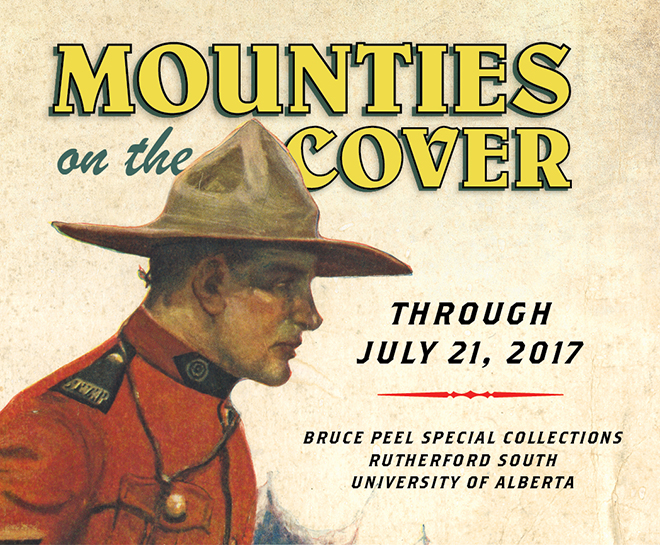
Mounties on the Cover is an exhibition containing highlights of a large and extraordinary collection of books that depict the Royal Canadian Mounted Police (RCMP).
The Mountie appeared in hundreds of Hollywood movies but was more often seen in the works of hundreds of artists and illustrators, on the covers of thousands of dust jackets, magazines, and comic books.
 |
| Robert Leighton.Sergeant Silk, the Prairie Scout. 1929. Robert Leighton (1859-1933) was born in Scotland. He wrote seven books about Mounties. This dust jacket appeared on many other children’s books not authored by Leighton and with no Mountie content, suggesting that it was used as a marketing tool. |
The collection represents 50 years of book collecting by distinguished Staff Sergeant (retired) Al Lund of the Royal Canadian Mounted Police, who generously donated his entire collection to the University of Alberta Libraries in recent years.
The exhibition opens to the public on Monday, March 20th in Bruce Peel Special Collections (Rutherford South, lower level). For more details: bpsc.library.ualberta.ca
Wednesday, June 22, 2016
Bruce Peel Special Collections Has Reopened!
 The Peel library is once again open, after the completions of a series of renovations to expand the capacity, and improve the security, of our special collections storage space.
Students, faculty, and the general public can once again access materials from Special Collections during normal hours. Please submit an online retrieval request form at least 24 hours before your visit to ensure that library materials have been retrieved from storage and are available for your use.
Peel library continues to welcome class visits. While the schedule for the fall term is now almost fully booked, we encourage you to contact us to book a future class visit.
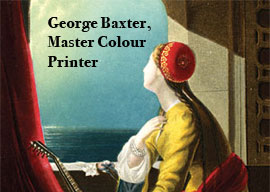
In celebration of the reopening, Peel is hosting two exhibitions. Our current in-house exhibition features gorgeous colour prints made by master printer George Baxter and highlights the impressive career of this Victorian period innovator.
Our new online exhibition highlights the university’s Honorary Degree recipients over the past fifteen years and the special rare books which have been purchased to honour them. It honours the accomplishments of such notable figures as k.d. lang, Wayne Gretzky, His Highness the Aga Khan, and Clara Hughes.
Subscribe to:
Posts
(
Atom
)


