Showing posts with label open access week. Show all posts
Friday, October 5, 2018
Open Access Week 2018
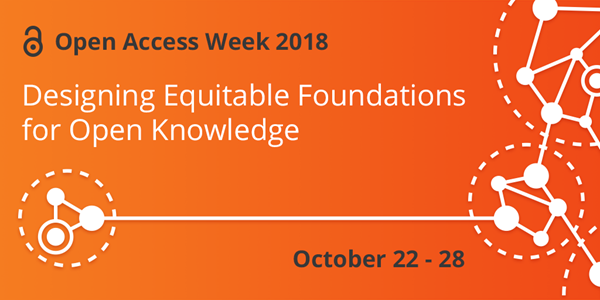
Here are a few local events you can attend! Find many more on the global 2018 OA Week Calendar, or follow #openaccessweek2018 on Twitter.
Monday, October 22
11:00 AM -12:00 PM, Senate Chamber (326 Arts and Convocation Hall)
Has the Open Access Movement Ossified? What Gains Remain to be Had and What Work Needs to be Done
As the 10th annual Open Access (OA) week begins, it is important to not just celebrate the gains made but also interrogate what the future holds for the OA movement.
Michael B. McNally from the School of Library and Information Studies will argue that with many substantive gains already made, from the adoption of OA in various funding models to the emergence (and capture) of OA as business model for scholarly publishing, that the OA movement has evolved into an increasingly ossified movement. The dream of OA as the mode for scholarly communication is dead.
Michael B. McNally from the School of Library and Information Studies will argue that with many substantive gains already made, from the adoption of OA in various funding models to the emergence (and capture) of OA as business model for scholarly publishing, that the OA movement has evolved into an increasingly ossified movement. The dream of OA as the mode for scholarly communication is dead.
Dale Askey, Vice-Provost and Chief Librarian, will respond to the presentation and provide his insights on what the future of scholarly publishing holds and what this means for advocates OA advocates. After the presentation and response there will be time for questions and discussion with the audience.
Registration now open!
3:30 PM - 5:00 PM
Documentary Screening: Paywall the Business of Scholarship

Join us at MacEwan University
Thursday, October 26, 2017
Spotlight on OER
Our friends at the Centre for Teaching and Learning are celebrating Open Access Week too! We asked them to share this guest post on Open Educational Resources for today's OAWeek post.
 Krysta McNutt, OER Project Manager, Centre for Teaching and Learning

This work is licensed under a Creative Commons Attribution 4.0 International License.
Revising and remixing content is the key to OER. By revising and remixing educational materials, instructors can customize and tailor their instructional materials to meet their students’ needs. By requiring students to revise and remix this content as assignments, instructors can create unique learning experiences, encourage discussion, debate, and uncover new perspectives.
Finding OER
Three common methods to discover OER is through the Creative Commons, BCcampus, or OER Commons websites. However, these are just three of many other ways.
The chart below can be helpful in determining what and how a selected OER may be used. For example, if you select a resource which carries a CC-BY-SA license, you may engage in all 5Rs but you must revise and remix the resource only with content which is also of the same license (CC-BY-SA).
Taking the First Step
If you’re interested in exploring OER further, whether it is to adapt existing work, adopt it into your course, or create new content, the Libraries and CTL are here to help!
Your Subject Librarian can be a great starting point. You may also want to check out the CTL Open Education page and consider booking a consultation, read more on the open education movement on the UA Libraries Open Education libguide, or join the UofA OE Interest Group.
Upcoming Workshops
Further Information
McNutt, K., Wakaruk, A. (2017), “Speedy Intro to Open Education”, Centre for Teaching and Learning, University of Alberta, October 24, 2017, https://docs.google.com/presentation/d/1uwU_vRxUXMAdS3nqtVAm4Ffg-gqjMdM98Oc_F0iCiDs/view
Wiley, David. “Defining the "Open" in Open Content and Open Educational Resources.” Iterating toward open, https://opencontent.org/definition/
Spotlight on OER
 Krysta McNutt, OER Project Manager, Centre for Teaching and Learning
OER (open educational resources) are teaching and learning materials that allow free use and reuse, without charge. OER often have a Creative Commons license that states specifically how the material may be used, reused, adapted, and shared.
OER can unlock freedom and creativity in the classroom. Instructors are exploring the use of OER to reduce textbook costs, customize activities and assignments, increase engagement with learning materials, and even co-create resources with students. Adapting and sharing OER also builds community among educators and scaffolds collaborative practice.
Using OER in place of a textbook or other proprietary learning material opens the door for student agency in how they consume this material (for example, students may re-format the content in a way that is more palatable to their learning preference), and the opportunity for instructors to facilitate activities such as non-disposable assignments.
David Wiley’s 5Rs are frequently cited as defining traits of OER.
OER can unlock freedom and creativity in the classroom. Instructors are exploring the use of OER to reduce textbook costs, customize activities and assignments, increase engagement with learning materials, and even co-create resources with students. Adapting and sharing OER also builds community among educators and scaffolds collaborative practice.
Using OER in place of a textbook or other proprietary learning material opens the door for student agency in how they consume this material (for example, students may re-format the content in a way that is more palatable to their learning preference), and the opportunity for instructors to facilitate activities such as non-disposable assignments.
The true power of open comes not from a resource being free of cost but rather from the freedoms to reuse, retain, redistribute, revise, and remix content. These freedoms empower both students and faculty while widening access and supporting the democratization of education. (Jhangiani).Using OER allows educators to customize content to increase relevancy and ensure inclusivity. By sharing educational material “in the open” with open licensing, the impact reaches beyond students at the University of Alberta by increasing accessibility and availability to informal and lifelong learners.
David Wiley’s 5Rs are frequently cited as defining traits of OER.
 |
| Credit: Image by BC campus, CC-BY 4.0 |
Wiley states: “Open educational resources are defined as “any copyrightable work that is licensed in a manner that provides users with free and perpetual permission to engage in the 5R activities”.
Open Licensing your educational content is one way instructors can get started with OER. AASUA members retain the copyright in the course materials they create and assign an OER-compatible licence. The copyright status on your work does not change when a standard open licence is assigned, such as Creative Commons.
1. Choose a licence
2. Mark the work with the CC icon
3. Link icon to licence deed (e.g. https://creativecommons.org/licenses/by/4.0/)
4. Include a statement.
1. Choose a licence
2. Mark the work with the CC icon
3. Link icon to licence deed (e.g. https://creativecommons.org/licenses/by/4.0/)
4. Include a statement.
Example:
This work is licensed under a Creative Commons Attribution 4.0 International License.
Revising and remixing content is the key to OER. By revising and remixing educational materials, instructors can customize and tailor their instructional materials to meet their students’ needs. By requiring students to revise and remix this content as assignments, instructors can create unique learning experiences, encourage discussion, debate, and uncover new perspectives.
Finding OER
Three common methods to discover OER is through the Creative Commons, BCcampus, or OER Commons websites. However, these are just three of many other ways.
The chart below can be helpful in determining what and how a selected OER may be used. For example, if you select a resource which carries a CC-BY-SA license, you may engage in all 5Rs but you must revise and remix the resource only with content which is also of the same license (CC-BY-SA).
 |
| Credit: Image “Wiley’s 5Rs and Creative Commons Licensing” by Krysta McNutt, CC-BY 4.0 (to view the full version, click here) |
If you’re interested in exploring OER further, whether it is to adapt existing work, adopt it into your course, or create new content, the Libraries and CTL are here to help!
Your Subject Librarian can be a great starting point. You may also want to check out the CTL Open Education page and consider booking a consultation, read more on the open education movement on the UA Libraries Open Education libguide, or join the UofA OE Interest Group.
Upcoming Workshops
- Speedy Intro to Open Education (webinar) October 27, 2017, 9:00am - 10:00am
- Finding, Creating, and Using OER (CTL) November 7, 2017, 12:00pm - 1:00pm
Further Information
McNutt, K., Wakaruk, A. (2017), “Speedy Intro to Open Education”, Centre for Teaching and Learning, University of Alberta, October 24, 2017, https://docs.google.com/presentation/d/1uwU_vRxUXMAdS3nqtVAm4Ffg-gqjMdM98Oc_F0iCiDs/view
Wiley, David. “Defining the "Open" in Open Content and Open Educational Resources.” Iterating toward open, https://opencontent.org/definition/
Tuesday, October 24, 2017
UAlberta Libraries: Open in Order to …

This week we’re celebrating Open Access Week 2017! The theme this year is “Open in order to _____”, so we thought we’d take some time to highlight some of the ways we support open access all year long.
The University of Alberta Libraries supports open in order to…
-make results of our researchers’ hard work available and visible to everyone, including other researchers, policy-makers, practitioners, students, and the general public,
-contribute to fair and equitable access to information for the widest possible audience,
-reduce the costs of education for students, and
-remove barriers to sharing and reusing research.
What are some of the ways we do this?
Our people:
We are experts in “open.” Our team helps researchers and students across the University navigate the world of open access, open data, and open education. Watch for workshops and events, or contact your subject librarian with specific questions. Throughout the Libraries, supporting open access, open data, and open education through our many diverse roles - from copyright and licensing expertise, to metadata and discovery work - is part of what we do every single day.
Our open access institutional repository:
 The University of Alberta’s institutional repository, ERA: Education and Research Archive (and ERA A+V) provides free and open access to the University of Alberta’s intellectual output, including journal articles written by UofA researchers, theses and dissertations by UofA graduate students, reports, conference proceedings, posters, datasets, and more.
ERA is an easy, convenient, and no-cost way for faculty to make their research open! For help depositing your work in ERA contact erahelp@ualberta.ca.
Our open publishing and digitization initiatives:
For more than 10 years, the UofA Libraries have been publishing open access journals, and now provide free-of-charge journal hosting for any open access Canadian journal. This service has expanded to include more than 45 titles, representing a diverse range of subject areas, from important local and Canadian journals to student and community publications. Using the open source software, Open Journal Systems, we've helped editorial teams publish thousands of articles, all freely accessible for researchers, policy makers, practitioners, and students around the world.
We also have been working hard to make important materials from our collections and partner libraries open and available through an extensive digitization program. Our Peel’s Prairie Provinces website hosts thousands of historic photos, newspapers, books and pamphlets we’ve digitized. Many collections once hidden on our shelves are now available online, open and free for anyone.
Open data:

Monday, October 23, 2017
Celebrating Open Access Week!
Every year, universities, colleges, research institutes, and libraries around the world host events celebrating Open Access Week, an opportunity to explore and promote open access in its many different forms. This year's Open Access Week runs from October 23 - 29. The theme, "Open in order to ..." is an invitation to answer the question of what concrete benefits can be realized though open access.

We've put together a list of our top picks for FREE events happening here at the UofA, and online. Find many more on the global 2017 OA Week Calendar, or follow #openaccessweek2017 on Twitter.
11:30 am - 12:30 pm Scholarly Communications Workshop, CAB 345, University of Alberta
Join UofA librarians Alison Henry and Victoria Wong for a session on tools for collaborative work, open data and OA publishing.
Details and registration
12:00 - 1:00 pm Speedy Introduction to Open Education, 5-02D, Cameron Library, University of Alberta.
Details and registration

We've put together a list of our top picks for FREE events happening here at the UofA, and online. Find many more on the global 2017 OA Week Calendar, or follow #openaccessweek2017 on Twitter.
Tuesday, October 24
At the UofA11:30 am - 12:30 pm Scholarly Communications Workshop, CAB 345, University of Alberta
Join UofA librarians Alison Henry and Victoria Wong for a session on tools for collaborative work, open data and OA publishing.
Details and registration
12:00 - 1:00 pm Speedy Introduction to Open Education, 5-02D, Cameron Library, University of Alberta.
Details and registration
Online
8:30 - 10:00 am Fair, Open Free? Copyright, Open Licensing, and Academic Freedom in Canada Panelists: Ariel Katz, Jennifer MacInnis, Sam Trosow, Kelsey Merkley
Details and livestream from Ryerson University
10:30 - 11:40 am Keynote: Spotlight on Open Educational Resources Michael Geist
Details and livestream from Ryerson University
11:00 am - 12:00 pm What we talk about when we talk about Open Access
Webcast from the Association of College and Research Libraries
Details and registration
12:00 - 3:30 pm Open in order to … end extreme poverty
World Bank and OA Panel, Livestreamed from World Bank HQ in Washington, DC.
Details and livestream
At MacEwan University
11:00 am-3:00 pm Celebrating Edmonton’s Music: A Canada 150 Wikipedia Edit-a-thon
John L. Haar Library (multipurpose room 7-269), MacEwan University City Centre Campus 10700 - 104 Ave.
Details and registration
Online
9:00 am - 10:00 am Webinar: Speedy Intro to Open Education
Details and registration
8:30 - 10:00 am Fair, Open Free? Copyright, Open Licensing, and Academic Freedom in Canada Panelists: Ariel Katz, Jennifer MacInnis, Sam Trosow, Kelsey Merkley
Details and livestream from Ryerson University
10:30 - 11:40 am Keynote: Spotlight on Open Educational Resources Michael Geist
Details and livestream from Ryerson University
Wednesday, October 25
Online11:00 am - 12:00 pm What we talk about when we talk about Open Access
Webcast from the Association of College and Research Libraries
Details and registration
Thursday, October 26
Online12:00 - 3:30 pm Open in order to … end extreme poverty
World Bank and OA Panel, Livestreamed from World Bank HQ in Washington, DC.
Details and livestream
Friday, October 27
At MacEwan University Friday, October 27
11:00 am-3:00 pm Celebrating Edmonton’s Music: A Canada 150 Wikipedia Edit-a-thon
John L. Haar Library (multipurpose room 7-269), MacEwan University City Centre Campus 10700 - 104 Ave.
Details and registration
Online
9:00 am - 10:00 am Webinar: Speedy Intro to Open Education
Details and registration
Subscribe to:
Posts
(
Atom
)


