Showing posts with label Indigenous initiatives. Show all posts
Monday, June 10, 2019
Indigenous Initiatives Projects at UAlberta Libraries
#ualberta
,
collections
,
databases
,
decolonizing description
,
digital initiatives
,
Indigenous History Month 2019
,
Indigenous initiatives
,
special collections
No comments
:
Here at the library we have a stellar team of library folks working on indigenous projects to further our commitment to Truth and Reconciliation.
The team consists of:
Kathleen De Long, Associate University Librarian
Kim Bates, Learning Manager
Kayla Lar-Son, Academic Librarian Resident
Gabrielle Lamontagne, Indigenous Intern
Leigha Rind, Indigenous Intern
Geordie Cardinal, Public Service Assistant
Larry Laliberte, GIS Librarian
Debbie Feisst, Interim Head, HT Coutts Library
Sharon Farnel, Metadata Coordinator
Anne Carr-Wiggin, Coordinator, Indigenous Initiatives
Paul Gareau, Assistant Professor, Native Studies.
Here’s a quick overview of what they have been working on lately. Stay tuned for more updates on these projects in the future.
On May 8, 2019 Paul Gareau and Tanya Ball from the Faculty of Native Studies provided some insights into Indigenous Research Data Management (RDM) from the perspectives of a faculty member and a PhD student. Kayla Lar-Son (UAL Digital Initiatives) moderated the session while discussing the concept of Indigenous data sovereignty.
UAL staff have been working with health sciences students, faculty and clinicians to envision what a Health Sciences Indigenous Information and Learning Commons as part of the Health Sciences Library might be. Several engagement sessions with stakeholders have been held through March and April.
Kayla Lar-Son, Allison Sivak and Leigha Rind hosted library sessions for Native Studies - Aboriginal Women (NS 362) students before their class every Tuesday evening during the Winter 2019 term. To focus on building relationships, the sessions were casual and there was always time for coffee & visiting. The students were given instructional sessions about library services. They also visited Jessica Thorlakson in Cameron library for a 3D Printing tour, explored hidden gems in the Circumpolar collection, and created work for their class project, the Visual Arts Journal.
The team consists of:
Kathleen De Long, Associate University Librarian
Kim Bates, Learning Manager
Kayla Lar-Son, Academic Librarian Resident
Gabrielle Lamontagne, Indigenous Intern
Leigha Rind, Indigenous Intern
Geordie Cardinal, Public Service Assistant
Larry Laliberte, GIS Librarian
Debbie Feisst, Interim Head, HT Coutts Library
Sharon Farnel, Metadata Coordinator
Anne Carr-Wiggin, Coordinator, Indigenous Initiatives
Paul Gareau, Assistant Professor, Native Studies.
Here’s a quick overview of what they have been working on lately. Stay tuned for more updates on these projects in the future.
On May 8, 2019 Paul Gareau and Tanya Ball from the Faculty of Native Studies provided some insights into Indigenous Research Data Management (RDM) from the perspectives of a faculty member and a PhD student. Kayla Lar-Son (UAL Digital Initiatives) moderated the session while discussing the concept of Indigenous data sovereignty.
As part of a recent Instagram takeover, Indigenous Academic Resident Kayla Lar-Son highlighted some of the work that she is doing in Digital Initiatives (DI) including spotlighting some of UAL’s unique Indigenous collections. Currently, issues of Alberta Native News are in the process of being digitized in a project lead by DI Librarian Michelle Brailey.
The Decolonizing Description Project team has been actively engaging members of Indigenous communities both on and off the UAlberta campus in a holistic, collaborative, flexible and ongoing process to address problematic terminology in resource descriptions. Knowledge gathering events on North and Augustana campuses, as well as at the Maskekosihk (Enoch) First Nation open house, have been well received, and we have learned a great deal that we can apply to our practices. Further knowledge gathering sessions are being planned.
UAL staff have been working with health sciences students, faculty and clinicians to envision what a Health Sciences Indigenous Information and Learning Commons as part of the Health Sciences Library might be. Several engagement sessions with stakeholders have been held through March and April.
Kayla Lar-Son, Allison Sivak and Leigha Rind hosted library sessions for Native Studies - Aboriginal Women (NS 362) students before their class every Tuesday evening during the Winter 2019 term. To focus on building relationships, the sessions were casual and there was always time for coffee & visiting. The students were given instructional sessions about library services. They also visited Jessica Thorlakson in Cameron library for a 3D Printing tour, explored hidden gems in the Circumpolar collection, and created work for their class project, the Visual Arts Journal.
UAL is happy to announce a new electronic resource 4 Seasons of Reconciliation, a multi-media teaching unit that promotes a renewed relationship between Indigenous Peoples and Canadians. This educational initiative, developed for secondary, post-secondary and the workplace incorporates teacher guides, slideshows, videos and films along with engaging online portals.
Friday, May 31, 2019
Film Streaming at Rutherford Library for Indigenous History Month and LGTBQ Pride Month
#ualberta
,
film streaming
,
Indigenous History Month 2019
,
Indigenous initiatives
,
Pride Month 2019
,
Rutherford
,
ualberta
No comments
:

Please note that some of these films have graphic or disturbing content, or address issues that may be upsetting for some people. Viewers are encouraged to seek out support if they wish to after viewing these films.
Some mental health support services on campus include:
- First Peoples' House
- The Landing: Centre for Gender and Sexual Diversity
- Peer Support Centre (Student Union)
- Counselling & Clinical Services (UofA)
Event: National Indigenous History Month and LGBTQ Pride Month video celebration
Location: Learning Lounge, Rutherford Library North
Date: Each weekday in June
Time: 10:30-12:30 (film running times vary from 75 minutes to 2 hours.)
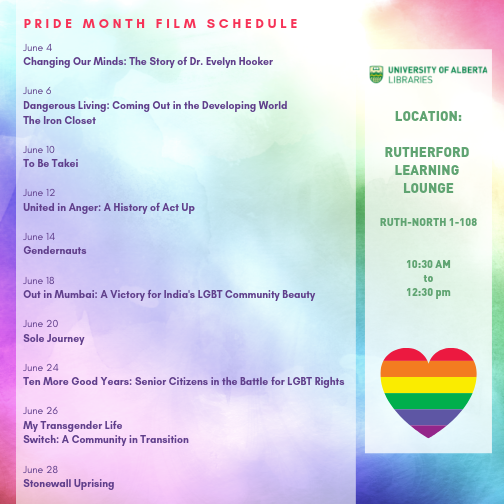
Film Schedule
Date
|
Title
|
Running Time
|
June 3
|
Amarok's Song - The Journey to Nunavut
|
1:15:00
|
June 4
|
Changing Our Minds: The Story of Dr. Evelyn Hooker
|
75:00
|
June 5
|
Kanehsatake: 270 Years of Resistance
|
1:59:00
|
June 6
|
Dangerous Living: Coming Out in the Developing World
The Iron Closet
|
58:03
27:04
|
June 7
|
Truth and Reconciliation: The Legacy of Residential Schools in Canada
Journey of Hope
|
30:00
60:00
|
June 10
|
To Be Takei
|
95:00
|
June 11
|
After The Last River
|
86:00
|
June 12
|
United in Anger: A History of Act Up
|
94:00
|
June 13
|
For Our Street Family
The Dugout
|
35:00
75:00
|
June 14
|
Gendernauts
|
1:23:53
|
June 17
|
We Were Children
|
1:23:06
|
June 18
|
Out in Mumbai: A Victory for India's LGBT Community
Beauty
|
54:28
23:00
|
June 19
|
Niigaanibatowaad: FrontRunners
Native Young!
|
47:00
30:00
|
June 20
|
Sole Journey
|
59:00
|
June 21
|
Sacred Buffalo People
The Sacred Relationship
|
40:00
52:31
|
June 24
|
Ten More Good Years: Senior Citizens in the Battle for LGBT Rights
|
1:10:52
|
June 25
|
Our Nationhood
|
1:36:00
|
June 26
|
My Transgender Life
Switch: A Community in Transition
|
48:00
52:10
|
June 27
|
The Road Forward
|
1:41:00
|
June 28
|
Stonewall Uprising
|
83:00
|
And here are some images in case you want to print off to quickly reference :)

Tuesday, January 22, 2019
Teaching Truth and Reconciliation: New Curriculum Materials Available
The University of Alberta community may use these educational materials in these ways:
- Unlimited simultaneous use of the films and media for students and teachers;
- Free public showings of the films (no ticket sales allowed); and
- Printing, copying, and displaying unit materials including maps, readings, and presentations.

Monday, October 29, 2018
Learning from First Nations, Métis and Inuit Peoples

New additions to the playlist include the eight part Canadian docu-drama series 1491: The Untold Story of the Americas Before Columbus, based on Charles C. Mann's best-selling book.
You may have heard about the new reality show, First Contact which shares stories of Canadians learning about contemporary life of Indigenous peoples. The show takes six people on a 28-day journey intended to challenge their racist, unsympathetic, and prejudicial attitudes and teach them about the modern day Indigenous experience. If you want to check it out, it’s available in this collection.
Monday, May 28, 2018
Visiting Artist Kevin Pee-ace unveils painting at Coutts Library
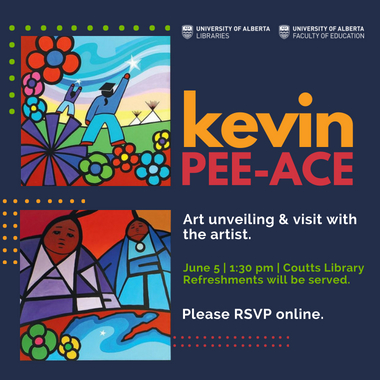
We are delighted that he will be in attendance at this event and will speak about his art. Elder Francis Whiskeyjack will also be in attendance.
Limited edition prints by the artist will be available for viewing and for sale. Refreshments will be served.
Date: June 5 at 1:30 pm
Location: Main floor of the Coutts Library, Education Centre, 11210-87 St.
RSVP: https://ualberta.libcal.com/event/3453856
Hosted by the Faculty of Education and the Coutts Library
Hosted by the Faculty of Education and the Coutts Library
 |
| Artist Kevin Pee-ace |
 |
| Special Prints of Pee-ace's work will be available for purchase at the event |
Thursday, February 8, 2018
Have a Heart Day for First Nations Children

"Reconciliation is all of us." ~ First Nations Child & Family Caring Society
Will you have a heart for First Nations youth? This is what Sarah Auger, a doctoral student in Indigenous Peoples Education: Educational Policy Studies, asked library staff. And so, you can come to the H.T. Coutts Library to extend your hearts with us.From February 10-16, you can get more facts about inequities faced by First Nations youth in education, health, and child welfare; sign a giant valentine to let your representatives know you support this cause; or write a note of encouragement to young people in their work to achieve their goals.
Have a Heart Day is a child and youth-led reconciliation event that brings together caring Canadians to help ensure First Nations children have the services they need to: grow up safely at home, get a good education, be healthy, and be proud of who they are.
This event is promoted by the First Nations Child & Family Caring Society. Groups all across Canada are hosting events to support youth!
In addition to events in different cities, youth and supporters will gather on Parliament Hill to promote love and fairness for First Nations children in celebration of Have a Heart Day. See images of more than 700 youth from 20 different schools (and their supporters) on Februrary 14, 2017.
Tuesday, January 9, 2018
Making Meaning Through Metadata: Are We Being Culturally Appropriate?
As a part of our commitment to the Truth and Reconciliation Commission (TRC)’s Calls to Action, UAL has formed the Decolonizing Description Working Group (DDWG) who have been working tirelessly on our library catalogue and metadata.
Metadata… that’s a scary word, isn’t it?
It doesn’t have to be! Metadata is just the fancy word for describing all of this:

It’s information about a material within the library. This can be anything from the title of a work to how many pages it has (which is especially important if you have a book review due in 3 hours).
Metadata seems innocent at first glance, but it can be very slippery. Look again at the image above. Do you see the “Subjects”? Here’s a blown-up view:

Subject Headings are used to connect similar resources together. These headings are actually created by a larger group of librarians within North America called Library of Congress (LOC). The purpose of LOC and other classification schemes is to make sure that all our libraries are speaking the same language by creating a controlled vocabulary so that students, faculty, and staff can travel from one University to the next and still be able to search. Plus, sharing this information makes it easy for us too -- we don’t have to create new catalogue records from scratch!
Now that you know that Subject Headings are, you may see some holes in the system. One of the biggest problems with this system is that changing it is a slow process. Language is changing so quickly everyday, that it’s tough to keep up!
At this point, we’re no longer making excuses.
With reconciliation in the air, we are asking ourselves whether or not we are appropriately and responsibly describing certain items in the library. Looking at our subject headings for Indigenous material, it’s clear that we have some work to do -- but we can’t do it alone.
Making Meaning Symposium
The DDWG has recommended that UAL start seeking advice from community members. One of the many ways that we are branching out is by hosting the Making Meaning Symposium (makingmeaningsymposium.ca) scheduled for February 8 & 9, 2018 at the Faculty of Extension in Edmonton, AB.
The two day event is open for 90 participants -- all free of cost! Programming will feature: panel discussions from Indigenous scholars and community members, keynote speakers, working groups, visual components, and food. Lots of food.
We are interested in hearing from different researchers, students and scholars about how how these subject headings has impacted your research.
Registration is now open, so hurry quick and put your name down!
Tuesday, November 28, 2017
Indigenous Reads: Beginning Your Reconciliation Journey at UAL
Many thanks to Kayla Lar-Son for her contribution to this article.
Working within Indigenous librarianship, we often get asked how people can participate in reconciliation. Reconciliation can be very slippery as it is a topic that is partnered with intense emotions coming both from Indigenous and non-Indigenous peoples. While there is a lot of work to be done towards reconciliation, it doesn’t need to be a scary task. Everyone can and should participate!
...but where to begin?
There are many everyday ways to start your own journey towards reconciliation. There are lots of resources to get you started too! For example, you can check out Crystal Fraser and Sara Komarnisky’s “150 Acts of Reconciliation for the Last 150 Days of Canada’s 150”. OR! You can view RISE’s (Reconciliation in Solidarity) eZine: 150 Everyday Acts of Reconciliation. This issue features artwork and ideas from people all around Edmonton. Both resources suggest curling up with a good book.
This suggestion gets a librarian stamp of approval! If you’re looking where to start, I suggest looking to Indigenous writers (there are a lot!).
These are some of our favourites:

If books aren’t your thing -- welcome to the club! Yes, I’m one of those crazy librarians that don’t read books. My books come in the form of Graphic Novels, Documentaries, and Children's Picture Books.

There are many everyday ways to start your own journey towards reconciliation. There are lots of resources to get you started too! For example, you can check out Crystal Fraser and Sara Komarnisky’s “150 Acts of Reconciliation for the Last 150 Days of Canada’s 150”. OR! You can view RISE’s (Reconciliation in Solidarity) eZine: 150 Everyday Acts of Reconciliation. This issue features artwork and ideas from people all around Edmonton. Both resources suggest curling up with a good book.
This suggestion gets a librarian stamp of approval! If you’re looking where to start, I suggest looking to Indigenous writers (there are a lot!).
These are some of our favourites:
- Traplines by Eden Robinson
- Motorcycles and Sweetgrass by Drew Hayden Taylor
- Dreaming in Indian: Contemporary Native American Voices by Lisa Charleboy and Mary Beth Leatherdale
- Half-Breed by Maria Campbell
- The Back of the Turtle by Thomas King
- Cree Narrative Memory: From Treaties to Contemporary Times by Neal McLeod
- One Story, One Song by Richard Wagamese
- Indigenous Writes: A Guide to First Nations, Métis and Inuit Issues in Canada by Chelsea Vowel
- Annie Muktuk and Other Stories by Norma Dunning
If books aren’t your thing -- welcome to the club! Yes, I’m one of those crazy librarians that don’t read books. My books come in the form of Graphic Novels, Documentaries, and Children's Picture Books.
- Deer Woman: A Vignette by Elizabeth LaPensée (Please note: any item that does not have a link are on order. We’ll have them soon!)
- Moonshot by Hope Nicholson
- Tales of the Mighty Code Talkers by Arigon Starr
- UNeducation, Vol 1: A Residential School Graphic Novel by Jason Eaglespeaker
- Love Beyond Body, Space, and Time by Hope Nicholson
- The Outside Circle: A Graphic Novel by Patti LaBoucane-Benson and Kelly Mellings
If you have little ones at home, you might want to consider stopping in to HT Coutts Education & Physical Education Library. There are puppets there. Yes, puppets! That, and they have loads of Children’s Picture Books. There are many great books surrounding reconciliation and Residential Schools in our collection, but when I read to my kids, I am drawn to the books that highlight our stories.

My kiddos love:
- Sweetest Kulu by Celina Kalluk and Alexandria Neonakis
- Little You by Richard Van Camp and Julie Flett
- Jenneli’s Dance by Elizabeth Denny and Chris Auchter
- How the Mouse Got Brown Teeth: A Cree Story for Children by George Littlechild
- This was one of my favourites to read as a child!
- Fall in Line, Holden! By Daniel W. Vandever
- Coyote Tales by Thomas King
- Dragonfly Kites by Tomson Highway
- The Raven and the Loon by Rachel Qitsualik-Tinsley
- Rabbit’s Snow Dance by Joseph and James Bruchac
Once the kids are in bed, I would suggest easing away from text for the evening. When you are in “chill mode”, pop in one of these documentaries. If the library doesn’t have a physical copy, consider scoping out some of UAL’s film databases. Criterion-on-Demand and Kanopy both have great, blockbuster flicks! So, skip Netflix for one night and look up these titles at the library:

- Rumble: The Indians Who Rocked The World
- Angry Inuk
- Highway of Tears
- We Were Children
- More Than a Word
- 8th Fire
- Colonization Road
Until next time…
Friday, October 20, 2017
Community and Healing with the Library

I’ve said this before…
Academic libraries are not just about books and research: they’re also about building communities. Oftentimes building a community is about positive relationships and helping people find the tools that they need to succeed.
Sometimes though, the best thing a library can do for a community is give them space to use the tools they already have.
Nantâwihiwêwin: Doctoring; healing day after day for a long time is a project that straddles this line, supporting those who participate to share their own stories, and turn our spaces into their own.
Started by Ambroise Cardinal-Dubitski, an Indigenous student specializing in Kinesiology, explains that Nantâwihiwêwin is:
“a zine that is meant to act as a tool for achieving the highest form of ‘decolonization’ which is to be healthy, resilient and Indigenous, especially while traversing the adversities of institutional learning and living.
[…] Words of empowerment, art, and poetry are on every page to aid the process of healing our physical, mental, emotional, and spiritual selves. Each page is taken as a reminder of our strength, love, and connection to the world as Indigenous Peoples, but also as a challenge. The challenge of healing in a world filled with racism, aggression, and harm towards Indigenous Peoples and people of colour.”
Hearing those words, my first instinct was to help.
Helping is the library way, after all. But how do staff, faculty, and members of an institution help when what students want is to empower, and speak for themselves?
My answer is to offer space, support, and a platform for outreach.
Living in a city with many universities and colleges, there are a lot of Indigenous students receiving an education. This meant that the project needed to extend beyond our University.
So, it has!
Currently, we are engaging students from the University of Alberta and Yellowhead Tribal College, and the hope is to extend the project to Grant MacEwan and other institutions. The Greater Edmonton Library Association (GELA) has also jumped on board: the association is currently working the Remand Centre to bring creative writing workshops to incarcerated peoples.
Nantâwihiwêwin was well received and created a special healing environment for everyone involved.
It leaves us with open hearts and open minds towards the notion of reclamation and healing as a community. If you or anyone you know may be interested in participating, the University of Alberta Libraries is hosting a Zine Making Workshop on October 25, at 2:30pm in the Kiva Room.
If you are unable to make it, you can always create a submission and bring it to HT Coutts Education and Physical Education Library. Otherwise, we look forward to distributing the final zine to everyone in our community.
Kinanâskomitin. “I am grateful to you”.
“Nantâwihiwêwin is a call to action as well as a gentle reminder, a reminder and invitation to the support and connection you have on your journey both internally, externally, spiritually, and physically.”
– Ambrose Cardinal-Dubitski
Thursday, October 19, 2017
Librarians Encourage Reconciliation Through KAIROS Blanket Exercises
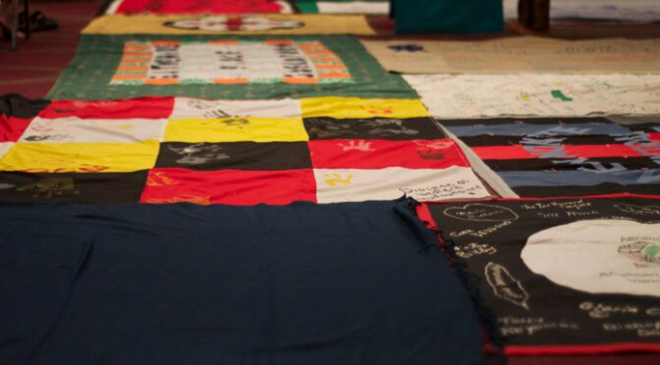 |
| Photo: http://www.holytrinitytoronto.org/wp-content/uploads/2016/02/blankets-672x372.jpg |
As a Métis person and educator, reconciliation is something that is near and dear to my heart. In fact, I have started working with RISE (Reconciliation in Solidarity Edmonton) to gain more understanding of my own family’s past in light of everything that has happened between Canada and Indigenous people. Through this journey, I am often faced with the question of: “how do you encourage reconciliation?” and “what is the most effective way to educate students about Indigenous history?” This is where I came across the KAIROS Blanket Exercise.
So, what is a Blanket Exercise?
I’ve been asked this questions many times. Whether it’s a family member at a holiday meal or a friendly conversation in the coffee line up, I always say the same thing. It’s a way to educate people on a topic that not everyone is fully aware of -- a way to present Canadian history from an Indigenous perspective.
This is a perspective that has been muted throughout history. In fact, remembering my elementary school days, I don’t recall learning much about Indigenous culture. To be honest, I think we spent more time talking about pirates than Indigenous Peoples. My own family history was muted as well. We were actively told to hide our true identity as a survival mechanism. This left me and my generation grossly unaware of the struggles that Indigenous Peoples have dealt with for more than 150 years.
The KAIROS Blanket Exercise is an excellent tool for building a more accurate image of how Canada came to be what it is now. Through an interactive script that engages all participants, it takes participants through time prior to any European settlers setting foot on Turtle Island. By immersing yourself into the activity, every participant feels the impacts that the Canadian government continues to have on Indigenous Peoples.
Now, what does this have to do with the library?
This is a tough, but wonderful question. Librarians are not all about books and databases. I see librarians as educators, activists, and helpers. Most important, libraries are a place of community. So, if a student and/or faculty member walks into the library I instinctively want to help.
This is what happened with EDU 211: Aboriginal Education and Contexts for Professional and Personal Engagement. A friendly conversation about library services evolved into a personal conversation about my involvement with RISE and my role in facilitating Blanket Exercises. It was the perfect combination of relationships and willingness to try new things in the classroom. Since that initial conversation, librarians gathered to help!
We gathered together in the Education Kiva room to share the exercise with 60 students and future educators. Since this initial Blanket Exercise, I have been asked to facilitate more within the Education community.
I am extremely grateful and humbled by the experience and being able to share my story with the students. By sharing these moments with the University community, I hope that this will help to inform future generations of instructors and students.
I am extremely grateful and humbled by the experience and being able to share my story with the students. By sharing these moments with the University community, I hope that this will help to inform future generations of instructors and students.
Hiy hiy.
Subscribe to:
Posts
(
Atom
)